
AI can help a leader organize a message. It cannot replace the judgment that makes the message worth hearing.
That is the danger most people are still underestimating.
When I say leadership communication skills are dying in the AI era, I do not mean human communication is disappearing. I mean too many professionals are starting to confuse polished language with original thought. They are mistaking a clean draft for clear judgment. They are outsourcing not just execution, but thinking.
At the same time, a different group is making the opposite mistake. They are ignoring AI completely and acting as if refusing to use it is a sign of wisdom or discipline.
Both groups are wrong.
The future belongs to people who know how to use AI without surrendering their voice, their judgment, or their ability to communicate under pressure.
McKinsey reported that only 13% of employees said generative AI was part of at least 30% of their daily work in late 2024, while the U.S. Census Bureau said overall business AI use hovered between 17% and 20% from December 2025 through May 2026. Adoption is real, but maturity is still uneven.
NVIDIA CEO Jensen Huang captured the risk clearly in May 2025: you may not lose your job to AI itself, but you could lose it to someone who knows how to use AI better than you do.
That is not just a technology issue. It is a leadership communication issue.
I have spent the last 20 years teaching leadership communication. I am a former TV producer for ABC, NBC, and FOX, and one thing has not changed: people still OVER-read PowerPoints to each other. People still bury the point. People still let ego, vagueness, and avoidable friction slow down work that should move faster.
Now AI is raising the stakes. It is giving people more ways to produce words without necessarily improving how they think, lead, or speak.
The real communication problem AI is exposing
AI is not exposing a grammar problem. It is exposing a leadership problem.
If an executive already rambles, AI can help them ramble faster. If a manager already hides behind corporate language, AI can generate even smoother corporate language. If a team already avoids hard conversations, AI can become one more buffer between people and clarity.
That is why this moment matters for Gen Z and for every generation working beside them. Many young professionals learned to write before AI became normal, but they are building careers in a world where AI assistance is quickly becoming expected. Gallup found in March 2025 that only about one-third of Gen Z adult workers in its Heartland study felt at least somewhat prepared to use AI in their current jobs.
The answer is not panic. It is training.

Why every employee will have to think more like a manager
One of the smartest ideas in the current AI conversation is that more people will have to learn how to manage, even if they never hold a formal management title.
That sounds dramatic until you look at how AI tools are evolving. They no longer just answer questions. More of them can carry out multi-step tasks, return with follow-up questions, request approval, revise outputs, and keep moving toward a result. That starts to look less like using a static tool and more like directing a junior colleague.
Microsoft's 2025 Work Trend Index has been explicit about this shift, arguing that every employee becomes an "agent boss" as AI agents join the workforce and people learn to build, delegate to, and manage them.
I think that framing is directionally right. In the past, only some employees had to learn how to delegate, coach, redirect, and hold the line on standards. In the next phase of work, almost everyone will need some version of those skills. They will need them with people, and they will need them with AI.
Which brings us back to leadership communication. The companies that move forward will be the ones whose people can:
- ask better questions
- give clearer direction
- detect weak reasoning
- push back on vague output
- align teams around a real point of view
Those are communication skills.
5 ways to save leadership communication skills in the AI era
1. Use AI to sharpen your thinking, not replace it
AI is useful for first passes, pattern spotting, and pressure-testing. It is dangerous when people treat its first answer as their final point of view.
Before you use AI to draft a memo, an all-hands message, a board update, or an interview answer, force yourself to answer three questions without it:
- What is my actual point?
- What decision or action do I want from the audience?
- What do I believe that is worth saying clearly?
If you cannot answer those questions yourself, AI is not your shortcut. It is your camouflage.
2. Stop rewarding polished vagueness
One reason leadership communication gets worse in AI-heavy environments is that polished language can now hide weak thinking more easily. A document can sound smart and still say almost nothing. A presentation can be beautifully organized and still avoid the real issue. A manager can show up with a clean script and still fail to lead.
The new premium is not polish by itself. It is specificity. Strong leaders should ask what the point is in one sentence, what action the audience should take, and what part of the message sounds generic.
3. Train people to communicate under pressure, not just on paper
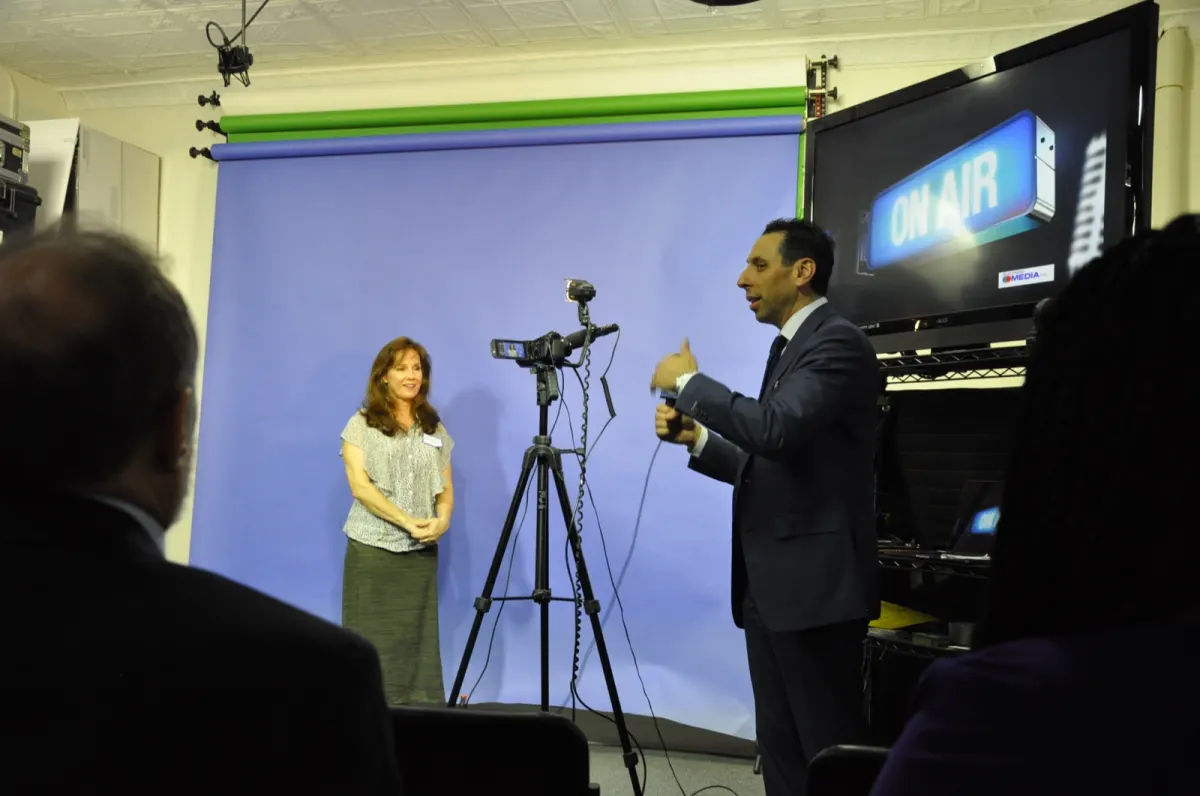
Many organizations still spend time on messaging documents, PowerPoint cleanup, and approved language, then assume the job is done. It is not done. Leadership communication is tested when the script disappears.
That could happen in a hostile media interview, a board presentation followed by difficult questions, an all-hands after layoffs, a keynote followed by unscripted Q and A, or a tense internal meeting where people are frustrated and impatient.
AI can help leaders prepare. It cannot substitute for repeated live reps, corrective feedback, and the ability to respond calmly in real time.
Thank you so much for your work with our entire team. We saw noticeable results and were able to make on-the-spot adjustments. I look forward to receiving your post-training materials and seeing what you have in store for us. Tim Wollerman, VP, Outreach, AARP
4. Teach employees how to manage AI like a colleague
People will need to learn how to direct AI with the same discipline good managers use with humans: give context, define the outcome, set constraints, review the work, challenge weak output, and ask for revision.
Microsoft's 2025 research found that 52% of respondents still saw AI mainly as a command-based tool, while 46% saw it as a thought partner. That gap matters. People who only issue shallow commands often get shallow work back. People who know how to iterate, refine, and challenge the output tend to get more value.
5. Build a culture where human clarity still matters
Wiley's 2024 survey found that 80% of respondents said soft skills were more important than ever as AI evolves, and 84% said they would still rather have difficult conversations face-to-face than use AI for them.
Even in an AI era, people still want clarity, trust, judgment, and human presence when the stakes are high. They do not want every hard moment mediated by a chatbot or flattened into perfectly neutral office language.
Leaders should reinforce a few standards right now:
- do not send an AI draft without actually editing it
- do not confuse long answers with strong answers
- do not let AI-generated language replace hard conversations
- do not reward jargon when clarity would do
- do not assume technology removes the need for coaching
The leaders who will win
The next generation of strong leaders will not be anti-AI. They will be better than that. They will know when to use AI for speed and when to slow down for judgment. They will know how to turn AI into a thought partner without letting it become a crutch. They will know how to communicate clearly to their colleagues, and increasingly, how to communicate clearly to their new AI colleagues too.
That is the skill that will help people stay valuable. It is also the skill that will separate companies that move forward from companies that quietly become more efficient at sounding empty.
After a robust, one-day training I went from being a disorganized and hard-to-watch talking head to an authoritative brand steward ready for the toughest interview. The value in Jess' approach was in his tough, real-time coaching and practical suggestions to manage the interview to ensure my message prevailed. Daniel Peirce, Investor and Advisor; ex-Gatorade, Starbucks, Welch's, adidas Group
Leadership communication skills are not obsolete. But in the AI era, they do need to be defended, retrained, and raised to a higher standard.
FAQ
Will AI replace leadership communication skills?
No. AI can support writing, summarizing, and preparation, but it cannot replace judgment, credibility, emotional calibration, and live communication under pressure.
What communication skills matter most in the AI era?
The most valuable skills are clarity, brevity, critical thinking, audience awareness, verbal agility, and the ability to guide both people and AI tools toward a useful outcome.
Why does AI make leadership communication more important?
Because AI makes generic language easier to produce. That raises the value of original thinking, clear direction, and a human point of view that audiences can trust.
How should leaders use AI without sounding robotic?
Use AI for structure, brainstorming, and rehearsal support. Do not let it make your final decisions, define your point of view, or become a substitute for real speaking practice.
Sources
- McKinsey on workplace generative AI adoption
- U.S. Census Bureau on AI use at U.S. businesses
- CNBC on Jensen Huang's May 28, 2025 remarks
- Gallup on Gen Z preparedness for AI at work
- Microsoft Work Trend Index 2025
- Wiley survey on soft skills in an AI era
- May 29, 2026: Original article published.
- August 2026: Add a short editor's note with any new examples, statistics, or shifts in point of view.
- November 2026: Add another short note if adoption patterns or AI-agent management examples evolve.