
The single biggest change in public relations is this: the wall between editorial and advertising, what we used to call church and state, has come down. For most of my career, a publicist's job was to get the media to report on a client with no mention of anything commercial. No website, no prices, no links, because coverage had to stay objective in an ocean of paid-for messaging. Those worlds have blended in unrecognizable ways. Getting a consumer product in front of the public today runs through earned media, product placement, and affiliate deals all at once. It is the Wild West out there right now, and I love it.
Why I will never retire from this business
I have been doing this for close to 40 years, and it is still a super fun business, because we are always learning about something different. Our clients are consumer packaged goods and the services people actually use: a pair of glasses, a ring, a piece of clothing, pet products, kid products, food, beverages, clean energy, even solar-powered EV chargers. Some are giant companies, many are small. You probably know Think Thin nutrition bars. We were the ones who set them up for their 217 million dollar acquisition to Glanbia. We have worked with Mrs. Fields Cookies and Perrier-Jouet Champagne, and back when I was a puppy in this business, with the Miss Universe and Miss USA pageants.
- Think Thin nutrition bars, positioned for a 217 million dollar acquisition to Glanbia
- Mrs. Fields Cookies and Perrier-Jouet Champagne
- Miss Universe & Miss USA pageants, in the early years
- Consumer packaged goods and services, from pet and kid products to clean energy
That pageant chapter taught me a lesson I never forgot. I did not know well enough who a reporter was who showed up on site to interview the girls. He brought a live broadcast camera and started asking controversial questions of contestants whose countries were, at the time, mortal enemies. I literally had to step in front of the camera and say, "Sorry, this is over." That is the job. You are the last line between your client and a moment that cannot be taken back.
What a client says they want is rarely what they need
Most human problems in a service business come up when there is a hidden expectation, one that is different from what the client says out loud. What our clients say they want and what they actually need are often two different things, so the first real work is getting crystal clear on the expectation underneath. Sometimes it is, "I just got into Walmart and I need to get feet in the door." Other times it is, "I built an 85 million dollar company in six years and I want to be on the cover of every magazine that talks about women business owners." Totally different jobs. Serve the wrong one well and you have still failed.
Case study: five doctors, one supplement line, and a media trainer
Here is a recent one that shows how all of this fits together. The client was 1MD Nutrition, a supplement company, and the campaign centered on a group of doctors, each behind a different formula: heart, gut, brain, prostate health. Brilliant people who spent years and real brain resources creating these blends. But brilliance is not the same as being ready for a camera.
When we come in, we build a platform, so the same information goes out over and over, with a lot of repetition of message. In this case, every single doctor needed to open with the same lead-in line before their own answer: "I believe in the power of nutrition." That is not a natural thing for a doctor to say. So I brought in a media trainer to get them there, and I stayed in the room for all of it. I sent Jess Todtfeld all kinds of messaging beforehand, probably drove him a little crazy, because getting the platform right is that important.
Why experts are the hardest people to put on camera
People are not naturally comfortable on camera. It takes a certain kind of person, and of all the entrepreneurs we work with, doctors are usually the toughest, precisely because they are experts. They want to tell you everything they know. In a short interview, that works against them: they get the first answer right, and then they go rogue. Afterward they will say it felt like an out-of-body experience and they have no idea what happened, while the publicist in the green room is pulling out every last hair.
The fix is discipline, not more information. A strong lead-in line. Two or three core messages. Repetition until it clicks, because people usually have to do it over and over before it really sets in. For longer formats like podcasts, I insist on seeing what a reporter plans to cover in advance, and I hand my client a simple outline of two or three things to keep in mind. I have even stood behind the camera with cue cards, mouthing "this, this, this," to make sure the message they worked so hard to build actually makes it out of their mouth.
- One lead-in line everyone opens with, before their personal answer
- Two or three core messages, repeated until they stick
- Pre-cleared topics from the reporter, and a short outline for the client
- Practice, then practice again: the message has to survive the pressure of a live camera
Alyson's Two Lanes
There are two front doors. Brown & Dutch PR has been around since 1996: a full-service firm running customized campaigns for brands ready to invest in the whole arc of press and placement. And Consumer Product Events is a matchmaking service between products and press, a truncated, flat-fee, affordable version for people who have a product that needs to be out there but are not ready for a full PR firm. Different budgets, same goal: get your product in front of the people who should see it.
Watch the conversation
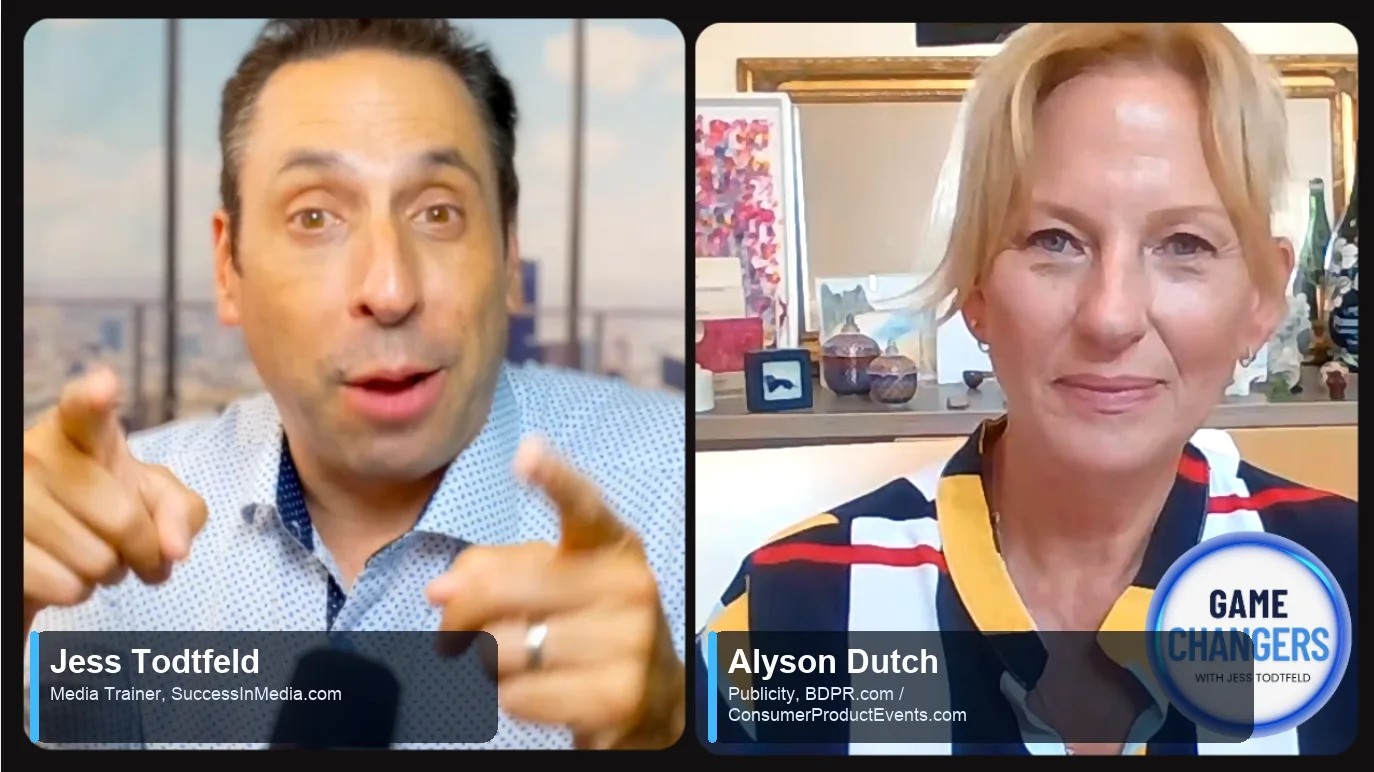
Jess Todtfeld and I sat down to talk through the changing face of PR, the 1MD Nutrition campaign, and what it really takes to keep a client calm and on message. Here is the full conversation.
The real job is being the calm in the storm
Strip away the tactics and this is what a good publicist actually does: absorb the chaos so the client does not have to. You keep everyone calm, you make sure the temperament in the room is right, you feel the pressure so they can stay focused on what they came to do. And when someone lands an amazing answer or a genuine soundbite, you are the one cheering, because that is the moment the whole campaign was built for.
Common questions
How do consumer products get into the media now?
The line between editorial and advertising has blended, so products now reach the public through a mix of earned media, product placement, and affiliate deals. The brands that win pair the right introductions with a clear, repeatable message and the discipline to stay on point on camera.
Why are experts and doctors hard to put in front of a camera?
Experts want to share everything they know. In a short interview that works against them: they answer the first question well, then go off track. The fix is a strong lead-in line, a short set of core messages, and repetition, so the same idea lands every time.
What is the difference between Brown & Dutch PR and Consumer Product Events?
Brown & Dutch PR is a full-service public relations firm running customized campaigns since 1996. Consumer Product Events is a flat-fee matchmaking service that connects products with press, an affordable option for brands that are not ready for a full PR firm.