How do you make the most of a media interview? Refuse to lower the bar to just not looking foolish. Aim higher on purpose: strong delivery, genuine value for the audience, and a planned call to action, so every segment produces a result and not just a recording. The interview is not something to survive. It is a platform you get to use.
Here is the pattern I watch play out again and again. Someone lands a great booking and says, this is a real opportunity, I want to do something with it. Then the camera light comes on, nerves show up, and the goal quietly shrinks. The new target becomes as long as I don't look stupid. We have all been there. But that is a survival goal, and survival goals produce forgettable interviews.
Why this matters (and what most executives get wrong)
An interview where your only aim is to avoid embarrassment is an interview you have already wasted. You will answer the questions, sound acceptable, and leave nothing behind. The audience forgets you before the next segment starts, because you never gave them a reason to remember or a next step to take.
What most executives get wrong is treating a raised bar and a lowered bar as if they carry the same risk. They do not. Playing it safe feels responsible, but safe on camera reads as flat, and flat is its own kind of failure. The people who get invited back, quoted, and acted on are not the ones who avoided mistakes. They are the ones who brought energy, said something useful, and pointed the audience somewhere.
So the fix is to decide, before you sit down, that your bar is not survival. Your bar is impact. That single decision changes how you carry your body, what you choose to say, and how you close.
The goal is never to avoid looking stupid. The goal is to be worth remembering. Set that bar before the light turns on, because you will not raise it once you are nervous.
The 3-part method to raise the bar in every interview
Raising the bar is not a personality trait, it is a checklist you run before you go on. Three parts, and each one lifts the interview past mere survival: how you deliver, what you give, and where you send people.
Step 1: Deliver with style and substance
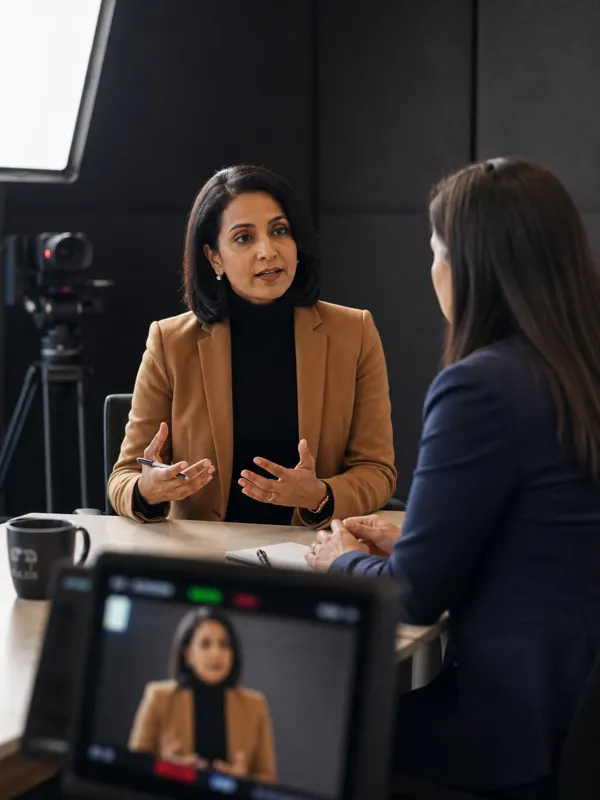
Style and substance are not opposites, you need both. Substance is the content that earns trust. Style is what makes people actually take it in. On camera that means your head, your hands, and your body are alive, not frozen. Move with intention, gesture, and let your face show that you care about what you are saying. A great point delivered like a statue still loses the room. Look interesting and you earn the right to be believed.
Step 2: Deliver massive value to the audience
Stop thinking about how you look and start thinking about who you are helping. Ask one question before every interview: how can I help the people I am talking to, or talking through this interviewer to reach? When you aim to be genuinely useful, give a real tip, a clear idea, something a viewer can act on today, you stop performing and start serving. That shift is what audiences feel, and it is what makes them lean in.
Step 3: Build in a call to action so the interview produces results
Most people leave the interview without ever inviting the audience to do anything, then wonder why nothing happened. Decide in advance the one action you want a viewer to take, and plan how you will prompt it without sounding like an ad. Often it is a resource you mention that leads the host to ask where to find it. Plant that setup on purpose. A call to action is what turns a nice appearance into actual return on the time you invested.
The mistake most executives make
The mistake is confusing not failing with succeeding. They walk off set relieved that nothing went wrong, and they call that a win. But an interview where nothing went wrong and nothing went right is a loss you cannot see. Relief is not a result.
The second version of the mistake is deciding, without realizing it, that dialing everything down is the safe choice. So they flatten their delivery, hold back their strongest point, and skip the call to action, all to avoid the small risk of trying too hard. What they actually avoid is being memorable. Playing small is not safe. It is just quiet failure with better posture.
Before you go on, ask: am I aiming to survive this, or to accomplish something with it? If the honest answer is survive, you have already lowered the bar. Name one specific result you want, and aim there instead.
Case study: the expert who was relieved instead of effective
A senior leader at a mid-sized firm came to me after a run of television appearances that, by his account, had gone fine. No gaffes, no awkward pauses, nothing to cringe at on replay. He was proud that he had not stumbled. So I asked what those appearances had actually produced. He paused. Nothing he could point to.
We raised his bar in three places. First, his delivery: we got his hands and face involved so he looked as engaged as he actually was. Second, his value: instead of vague industry commentary, he brought one concrete, useful takeaway to every segment. Third, his close: he decided on a single action he wanted viewers to take and rehearsed the line that prompted it. The next round of appearances looked and felt different, and for the first time his team could trace real interest back to the segments. His expertise had not changed. His bar had.
A survival interview versus a raised-bar interview
| What you bring | Survival interview | Raised-bar interview |
|---|---|---|
| Your goal | Don't look foolish | Be worth remembering |
| Your delivery | Still and careful | Style plus substance, alive on camera |
| Your focus | How you come across | How much you help the audience |
| Your close | No ask, no next step | A planned call to action |
| What you walk away with | Relief | A measurable result |
Read the bottom row again. Same person, same booking, same expertise. The difference between relief and a result is nothing more than the bar you set before the camera turned on.
What to do next
Before your next interview, do one thing: write down the single result you want it to produce, then plan the delivery, the value, and the call to action that will get you there. If your only goal is to avoid looking foolish, you have set the bar on the floor. Raise it on purpose.
If you want to walk into every interview aiming at a result instead of hoping to survive it, that is the work I do with executives and spokespeople. You can get a quick quote for working with me directly, and to sharpen the pieces, here is how to prepare for a media interview and how to leverage media interviews once the segment airs.
The opportunity is real the moment you get booked. Whether you make the most of it is a decision you make before you say a word.