
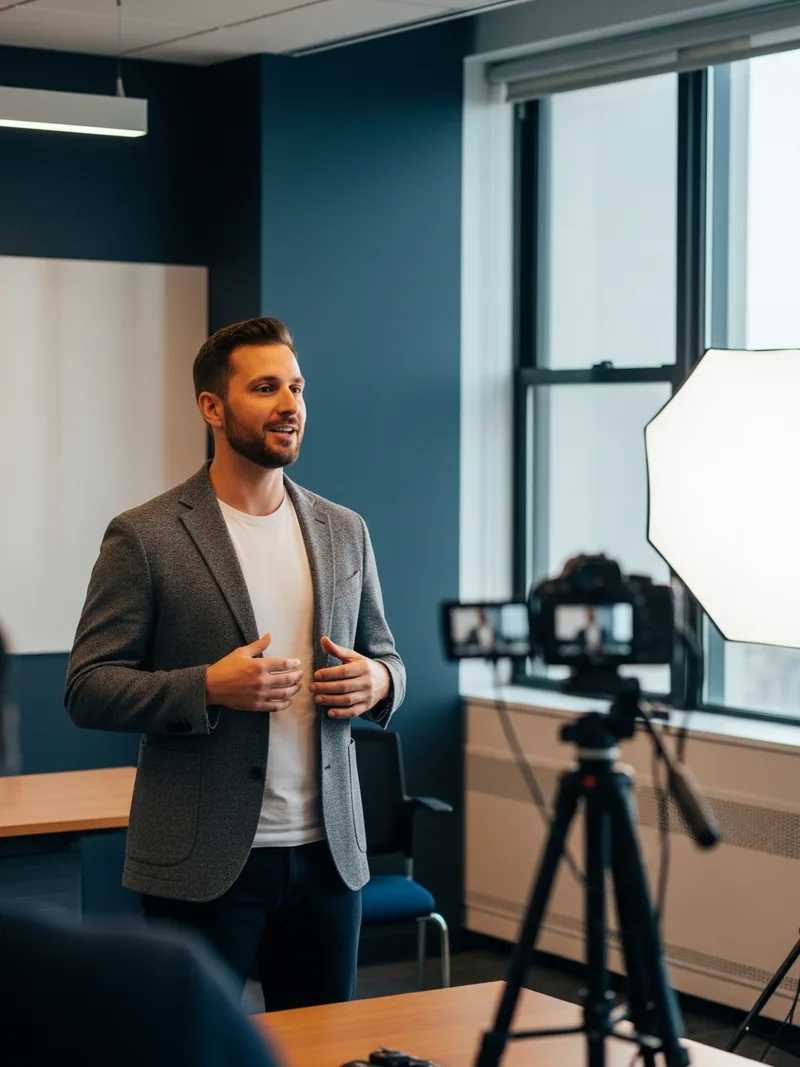
On camera training for subject-matter experts is the process of turning a person who is brilliant on paper into someone who is clear, engaging, and comfortable the moment a camera turns on. It works through record-and-playback reps, learning to lead with the point instead of the detail, and treating early takes as drafts rather than failures. The expertise is already there. The training frees it.
I once worked with a technical specialist preparing for an internal video series. In the room he was sharp, precise, genuinely fascinating. The instant the record light came on he went stiff, dropped into a monotone, and buried his best idea under four minutes of setup. He was not short on knowledge. He was short on reps.
Why on camera training matters (and what most experts get wrong)
Here is the pattern I see over and over. A researcher, an engineer, a risk or finance specialist, a product expert: someone whose judgment the whole company trusts. Put them in a meeting and they command the room. Point a camera at them and they freeze, go rigid, or flatten into a monotone that makes even a great idea sound like a compliance disclosure.
Experts in this seat often assume the problem is confidence, or that they simply are not a camera person. That is almost never it. The real issue is that the camera changes nothing about what they know and everything about how they deliver it. Their instinct on camera is to prove rigor by front-loading every caveat and every step, so the point lands last, if it lands at all.
The audience experiences the opposite of what the expert intends. The expert is trying to be thorough. The viewer just wants to know what matters and why. When the point comes last, the viewer has already tuned out, and a team that records internal podcasts or video ends up with content nobody finishes.
The camera does not expose a lack of knowledge. It exposes a delivery habit, and a habit is something you can retrain.
The 5-step on camera training method for technical experts
This is the sequence I run with experts who need to be watchable, not just correct. Five steps, in order. None of them ask you to become a different person; they ask you to get your real self through the lens.
Step 1: Lead with the point, not the setup
Say your conclusion first, in one plain sentence, then earn it with the detail. Experts instinctively build the case before the verdict, which is right in a paper and wrong on camera. Flip it. Open with the answer, the risk, or the takeaway, and let the supporting detail follow. Leading with the point is the single fastest upgrade a technical speaker can make.
Step 2: Build sound bites with the Sound Bite System
A sound bite is a short, quotable, self-contained statement of your key idea. The Sound Bite System is how you build them on purpose instead of hoping one falls out. Take your most important point and compress it into a line a non-expert could repeat. When you have a few of these ready, you stop rambling toward your idea and start landing it cleanly, on camera or in a Q&A.
Step 3: Record a take and play it back
You cannot fix what you cannot see, and you genuinely cannot feel your own stiffness in the moment. So capture a take on any camera you have and watch it back. Notice where the energy drops, where the monotone creeps in, where the point got buried. This playback is uncomfortable and it is the whole engine of the work. The wince you feel watching yourself is more useful than any note I could write.
Step 4: Treat every early take as a draft
Nobody nails it on take one, and expecting to is what creates the freeze. Rename the first few takes in your head: they are drafts, not performances. A writer does not publish a first draft, and you do not have to keep a first take. When the pressure to be perfect on camera comes off, the stiffness comes off with it, and the retakes drop from a dozen to two or three.
Step 5: Build reps until you see your own improvement
Comfort on camera is a trained skill, not a personality trait. Do short reps: record, play back, adjust one thing, record again. A few minutes at a time is enough. The goal is not a single perfect clip; it is the moment you watch a playback and think that actually sounded like me. Once you can see your own improvement, the camera stops being the enemy.
The mistake most experts make
The biggest mistake is trying to fix delivery by adding more preparation of the wrong kind. The expert who freezes on camera usually responds by writing more notes, memorizing more detail, and scripting every word, which makes the delivery stiffer, not looser. More rigor is not the cure for a delivery problem.
The other version of the mistake is going straight to the real recording with no reps first, then quietly deciding after a dozen bad takes that they are just not good on camera. That is not a verdict about the person. It is proof that the reps never happened. You train the delivery in low-stakes practice so that the real take is your third or fourth attempt at the skill, not your first.
Record sixty seconds explaining your specialty to a smart twelve-year-old. If the point comes in the first ten seconds and you sound like a person talking, you are close. If it takes a minute to arrive, you have found exactly what the training fixes.
Case study: the research scientist who buried the point
A research scientist was asked to front an internal video series explaining the team's work to the wider organization. The material was genuinely important and the scientist knew it cold. The early recordings were painful: long, flat, and so detail-heavy that the actual finding did not surface until the very end, by which point no one was watching.
We changed the order of operations. First we pulled the single most important takeaway to the front and built two sound bites around it, so every recording opened with the point instead of the runway to it. Then we recorded a take and watched it together. The scientist saw the monotone immediately, and seeing it did more than hearing me describe it ever could. We treated the next several takes as drafts, not performances, which took the pressure off, and the stiffness eased on its own. By the fourth or fifth rep the retakes had collapsed from a dozen to two, the energy was up, and the point landed in the first fifteen seconds. Same expert, same knowledge, delivery finally out of the way of the idea.
Freeze on camera versus trained on camera
| What the viewer experiences | Untrained expert | After on camera training |
|---|---|---|
| Where the point lands | Last, if at all | In the first few seconds |
| Energy and tone | Stiff, monotone | Warm, varied, human |
| Retakes needed | Many, low quality | A few, usable |
| How the expertise reads | Buried in detail | Clear and credible |
Look at the last row. The knowledge is identical in both columns. The only thing that changed is whether the delivery gets out of its own way, and that is exactly what the reps train.
What to do next
Start with one take today. Pick your single most important point, say it first in one plain sentence, record sixty seconds, and watch it back. That first honest playback is usually the moment the freeze starts to break.
If your team has experts who need to be watchable on internal video, podcasts, or interviews, that is the work I do. You can get a quick quote for working together, see what our executive media training covers, and read what real media training actually involves.
Your experts already have the substance. On camera training is how you get it through the lens.