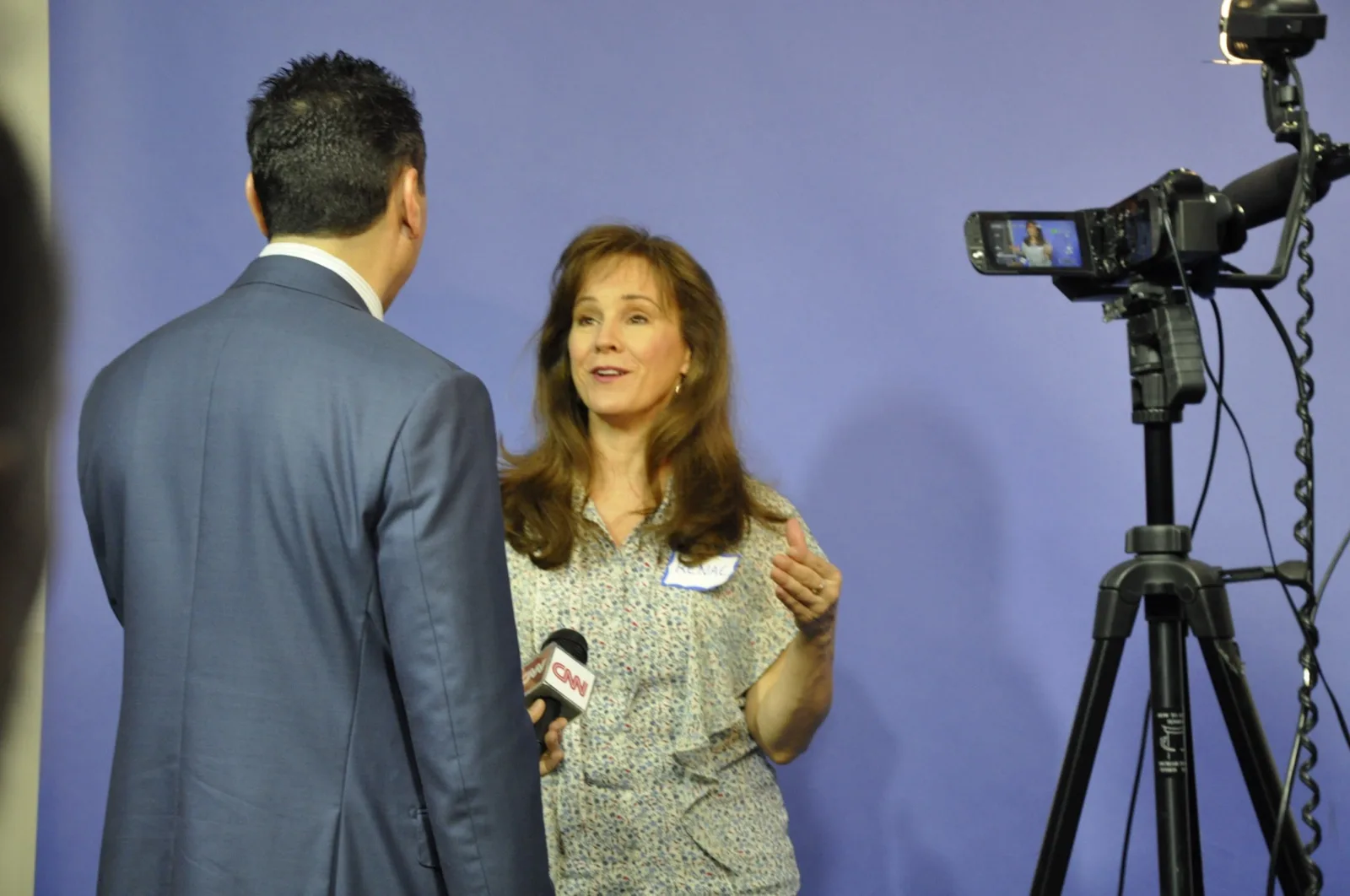
Executive presence coaching is one-on-one training that develops how a leader commands attention: voice, body language, message discipline, and composure under pressure. The most effective coaching replaces abstract theory with recorded on-camera practice and instant playback, so you see exactly what the room sees and change it in real time.
Presence is not a personality trait. It is a set of trained behaviors.
Walk into any boardroom and you can feel it within seconds: some leaders hold the room and some lose it. The difference is rarely intelligence or title. It is a cluster of observable behaviors: how they open, how they pause, where their eyes go, what their hands do, and whether their message stays disciplined when the questions turn hostile.
Because those behaviors are observable, they are trainable. That is the entire premise of this coaching. Jess Todtfeld spent 13 years as a television producer for NBC, ABC, and Fox, deciding which executives looked credible on camera and which ones got cut. That producer's eye is now pointed at you: every exercise is recorded, played back immediately, and adjusted on the spot. You do not leave with notes about presence. You leave with footage of yourself demonstrating it.
Executive presence is the ability to command a room, a camera, and a crisis. It rests on four trainable pillars: a controlled, confident voice; body language that signals authority; message discipline that survives interruptions; and composure that holds under pressure.
Executive presence exercises you can practice today
You do not need a studio to start. These are five of the same executive presence exercises we use in coaching sessions, adapted so you can run them on your own with nothing more than a phone camera. Practice them recorded whenever possible: the playback is where the learning happens.
1. The 10-second open
Record yourself delivering only the first ten seconds of your next presentation or meeting, then watch it back. Most leaders burn their opening on throat-clearing: "Thanks for having me, I know everyone is busy." Rewrite the open so your first sentence states the headline of what you want the room to decide or remember. Repeat until the open lands inside ten seconds with no warm-up.
2. Camera-eye contact reps
On video calls, the camera lens is the other person's eyes, yet most executives stare at faces on the screen and appear disengaged. Practice delivering two minutes of content looking only at the lens, with your notes taped just beside it. Watch the recording: when your eyes lock on the lens, you read as direct and confident; when they drift, you read as distracted.
3. The pause-and-land exercise
Pick the three most important sentences in your next talk. Deliver each one to camera, then hold a full two-second silence before continuing. It will feel uncomfortably long; on playback it reads as command. Leaders who rush past their key lines bury them. The pause tells the room: that sentence mattered, write it down.
4. The one-message exercise
Have a colleague fire five unrelated questions at you on camera. Your job is to answer each one honestly in a sentence, then bridge back to your single core message every time. This builds the message discipline that defines presence in interviews, Q&A, and crisis moments: you stay responsive without surrendering control of what the room remembers.
5. Playback self-review
Once a week, record two minutes of yourself speaking and review it with the sound off first: posture, gestures, facial energy. Then listen with the screen off: pace, filler words, vocal drops at the ends of sentences. Separating the channels reveals habits you cannot hear and tics you cannot see. Log one fix per week and re-record.
These exercises will move you forward on your own. What coaching adds is a trained external eye: a producer who can see the half-second habits you will never catch yourself, and who can pressure-test you with the kinds of questions and curveballs a phone camera cannot throw.
Want a producer's eye on your next high-visibility moment?
Speak with JessWho executive presence coaching is for
C-Suite Executives
Leaders whose board meetings, earnings calls, all-hands, and media moments demand a presence that matches the title.
Rising Senior Leaders
High performers told they need "more executive presence" to reach the next level, with no one able to define what that means. We define it, film it, and build it.
Founders & Entrepreneurs
Founders facing investors, customers, and cameras where the company is judged by how its leader carries the room.
Technical Experts Moving Up
Specialists with deep credibility on substance who need their delivery, voice, and body language to carry the same weight.
How the coaching runs
Engagements are one-on-one and built around recorded practice with instant playback. A typical intensive runs a half day or full day: we film a baseline, identify the two or three behaviors costing you the most authority, then run targeted exercises on camera until the change is visible in the footage. You keep the recordings, so the before-and-after is undeniable.
- NYC studio: sessions at our Madison Avenue training space with full camera setup
- On-site: we bring the cameras and the coaching to your offices, anywhere in the world
- Virtual: live coaching over video with the same record-and-playback cycle, ideal for distributed leaders and ongoing reinforcement
Many clients pair this work with executive communication coaching when the priority is message and structure, or with high stakes presentation training when a specific pitch, board meeting, or keynote is on the calendar. Leaders who face press add executive media training; our media training hub covers those programs in depth.
How much does executive presence coaching cost?
Executive presence coaching engagements typically range from $1,000 to $15,000 depending on scope and format. A single virtual coaching session sits at the lower end of that range; a full-day one-on-one intensive in our NYC studio or at your offices, with follow-up sessions and between-session review, sits at the higher end.
Every engagement is scoped to the leader and the moments they are preparing for, so the most useful next step is a conversation. You can review our frequently asked questions or go straight to a pricing inquiry for a number matched to your situation.
About Your Coach: Jess Todtfeld
Jess Todtfeld spent 13 years as a TV producer for NBC, ABC, and FOX, where he made daily judgments about who looked credible on camera and who did not. He is a Guinness World Record holder for 112 media interviews in 24 hours, 96 officially certified, carries the Certified Speaking Professional (CSP) designation, and is the author of the bestselling book Media Secrets. He has coached leaders at Google, JPMorgan, American Express, and the United Nations. Learn more about Jess.