Media training for senior executives teaches leaders to stay on message when an interviewer takes them somewhere interesting but irrelevant. In this case study from my work with AIG Insurance, one senior leader learned that lesson so vividly on camera that he was still using it two years later, and he wrote to tell me so.
I worked with AIG Insurance for eight years. AIG is a worldwide insurance company, and I was brought in to work with country presidents from around the world. These were multiple days to a week of executive leadership training, and my part of it was leadership communication: a presentation training workshop one day, and a media training workshop for senior leaders the following day.
Do these techniques translate to other cultures?
People ask me all the time if the techniques I teach translate to other cultures and to companies that work outside of the United States. The short answer is yes. There are some things that are universal: becoming more interesting, becoming more succinct, getting to the point, using stories and analogies in the right way, and not data dumping. Being in control of a room or a media interview. All of these are what people from around the world tell me they want, and exactly what my job is to deliver.
It helps that I have trained members of the United Nations for more than 15 years, so I am very sensitive to cultural differences and to what will actually work for a particular group in their region. When a room holds country presidents from a dozen different markets, that sensitivity is not optional.
The trap: the world of everything we know
In the media training day, I talk about how tempting it is to speak from what I call the world of everything we know. It is the polar opposite of the three columns of information each leader fills out, which become their core media messaging. That message system is one of the pillars of the training: a small, prepared set of messages you can access under pressure, instead of the entire universe of things you happen to know and could talk about for an hour.
When we get to the question-and-answer exercises, I instruct each person's partner to try to take them off track. I ask the partner to be difficult at times, or even confusing in the questioning, because we train for this. One important piece is seeing whether the person can avoid the land of everything they know.
What happens when the interviewer takes you off topic?
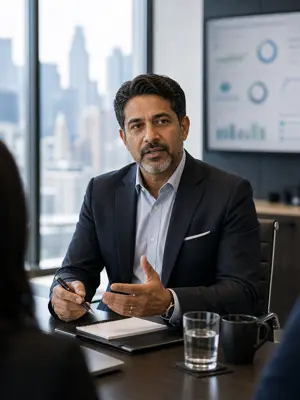
One of these senior leaders had mentioned during lunch that he had hiked to Mount Kilimanjaro base camp. It was a gripping story. But during the media interview exercise, it had no place. The interview was supposed to be about how they help their insurance clients.
So the colleague interviewing him asked, "Is it true that you just climbed a major mountain in the world?" "Oh, yes," said this senior leader. The next questions came quickly. Was it difficult? What did you learn about yourself? What can we learn from your experience?
This gentleman launched into a three-minute answer. As he was starting minute four, he stopped mid-sentence, looked right at the camera, and said, "None of this is important for my media messaging. I just realized that I'm completely doing the wrong thing, which I will never do again."
His partner laughed and said, "Okay, you get to have that question again. Let's see what you do." She asked the question again, and this time he handled it the trained way:
- A short, honest answer. He acknowledged the question instead of dodging it. Nothing evasive, nothing robotic.
- An authentic pivot. He used our authenticity system for pivoting, moving naturally from the mountain to the skills he uses every day.
- Back to the message. He landed on how he helps the clients and people he serves, which is what the interview was actually about.
When we played the recording back for the group, it got a huge round of applause. That is something most of these people never get from colleagues, because applause has no place in a normal meeting. In this meeting it was very warranted, and everybody got the message.
Two years later, the lesson was still working
Here is the part that makes this a case study and not just a good training story. Two years later, I got a message from this senior leader. He told me he thinks about that moment sometimes before an important interview, and that he has never once taken the bait and gone off message the way he did that day. He said the practice was invaluable, that it really shaped how he saw these conversations, and that it made him a better leader. He wanted to thank me, even two years later.
That is the return on a training day. Not a binder on a shelf, but a reflex that shows up before every important interview for years.
The bonus lesson: when my own PowerPoint died
One more story from an AIG presentation training day, because I need to practice what I preach. I teach leaders to be prepared if anything changes: if the PowerPoint stops working, if there is no microphone, if the electricity goes out, which has happened at venues where I have spoken.
That morning, my presentation was loaded on a thumb drive plugged into the computer at the front of the room. While I was greeting these senior leaders from around the world, one of them leaned against the screen to tell me how helpful the short homework assignment had been, knocked into the thumb drive, and cracked it in half. I watched my welcome slide turn off and the PowerPoint vanish. They had no idea the challenge they had unintentionally given me.
About 60 seconds later it was time to start. Instead of opening with a powerful video, I opened with a story about the exact topic that would have been in that video, and I said nothing about the disaster. The group found the story interesting and got to work on their exercises. The entire morning was completely about them and the practice they were doing, with everything video recorded and played back. At lunchtime, an assistant of mine arrived with a new thumb drive, and after lunch I showed the videos as planned.
At the end of the day, I asked if anyone had noticed a problem at the front of the room. Everyone looked confused. In fact, it was the opposite. They reported having a great time and said the training doubled as a team-building experience, since they rarely get to see their counterparts from other countries. When I shared what had happened, we talked about what they might do in a similar situation. Because everyone had been practicing all day, they felt they had the skills to take a deep breath and just start helping people. Notice I said helping, not speaking, because the sweet spot is being audience-focused instead of me-focused. A few people said this was one of the most powerful lessons of the day.
- The most dangerous question is the interesting one. Off-topic questions feel flattering. That is exactly why they pull leaders into the land of everything they know.
- Short answer, authentic pivot. The trained response is not dodging. It is a brief, honest answer followed by a natural pivot back to your core messages.
- Video playback makes the lesson stick. Seeing yourself go off message once on camera is worth a hundred warnings. This leader never repeated it in two years.
- The techniques are universal. Country presidents from around the world want the same things: interesting, succinct, in control.
- Prepare for the unexpected. Even the trainer's PowerPoint can crack in half. Audience-focused communicators just take a breath and start.
If your leadership team faces media interviews, analyst questions, or public scrutiny, this is trainable. You can read how the same systems worked for leaders at the Social Security Administration, or go straight to the details of our programs for insurance companies and executives. When you are ready, get a quick quote and I will map a training to your team.
About the author
Jess Todtfeld, CSP, spent 13 years as a television producer at NBC, ABC, and Fox, holds the Guinness World Record for the most media interviews given in 24 hours (112 completed, 96 certified), is a Certified Speaking Professional, and is the author of the international bestseller Media Secrets. He has trained executives, government leaders, doctors, and nonprofit spokespeople around the world.
Want to talk through a training for your team? Email [email protected] or call (646) 233-1424.
Not ready yet? Start with a copy of Media Secrets or the 7 Media Interview Secrets.