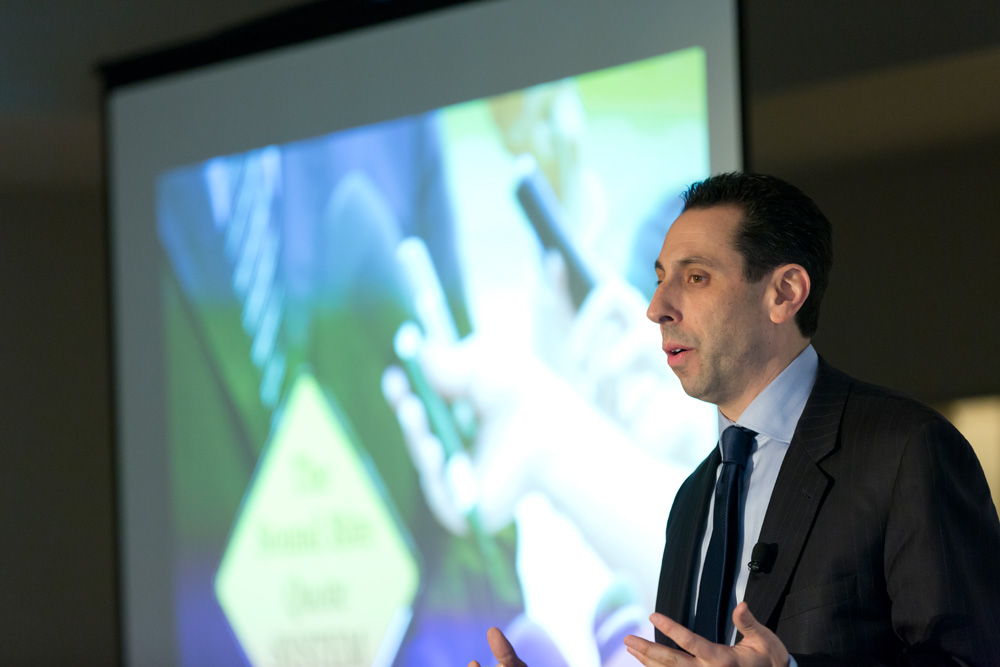
Leadership communication is the ability to hold a room and move people to action with or without slides, notes, or a working projector. I got to prove that definition the hard way, in front of AIG country presidents from around the world, about sixty seconds after my entire PowerPoint snapped in half.
I worked with AIG, one of the world's largest insurance and financial services companies, for eight years. I was brought in to work with country presidents from around the world during multiple days to a week of executive leadership training. My part was leadership communication: these presidents, as part of a small group, went through a presentation training workshop, and then on the following day, a media training workshop.
Do these techniques work across cultures?
People ask me all the time whether the techniques I teach translate to other cultures and to companies that work outside of the United States. The short answer is yes. Some things are universal:
- Becoming more interesting and more succinct
- Getting to the point
- Using stories and analogies in the right way
- Not data dumping
- Being in control of a room or a media interview
All of these are what people from around the world tell me they want, and delivering them is exactly my job. It helps that I have trained members of the United Nations for more than 15 years, which keeps me very sensitive to cultural differences and to what will actually work for a particular group in their region.
The thumb drive that snapped in half
One of my favorite stories from those eight years is about the day I had to practice what I preach. In the presentation workshop I talk about being prepared if anything changes. Prepared if your PowerPoint is not ready or stops working. Prepared if there is no microphone. Prepared if the electricity goes out, which has happened at venues where I have spoken.
That particular day, my PowerPoint was loaded on a thumb drive plugged into the computer at the front of the room. My PowerPoint is essentially a collection of videos of people like the ones in the training, shown doing something right. As I was greeting these senior leaders from around the world, one of them wanted to tell me how helpful the short homework assignment had been. While leaning against the screen at the front of the room, they knocked into the thumb drive and cracked it in half.
I watched my welcome slide turn off and the PowerPoint basically vanish. They had no idea the challenge they had unintentionally given me.
About sixty seconds later, it was time to start the training. Not the way I had intended, with a powerful video, but with nothing except my own leadership communication skills. I told a story about the exact topic that would have been in that video, and I did not tell them about the disaster that had just taken place.
What did the room notice? Nothing.
They found the story interesting and began work on their exercises. The entire morning was completely about them and the practice they were doing. As with any of my workshops, there were multiple exercises that were video recorded and played back, and the group was most focused on seeing their own improvement in real time.
At lunchtime, an assistant of mine showed up with a new thumb drive carrying a copy of the PowerPoint. This was before we could just have it delivered through the cloud. After lunch, I showed them a number of the videos, and we got back to work on their presentations.
At the very end of the day, I asked them if they had noticed a problem I had at the front of the room. Everyone looked confused. Nobody had any idea. In fact, it was the opposite: they reported having a great time and found the training not only helpful but a great team-building experience, since they rarely get to see their counterparts from other countries.
Then I shared what happened, and we talked about what they might do in a similar situation. Because everybody had been practicing all day, they all felt they had the skills to take a deep breath and just start helping other people. Notice I said helping, and not speaking, because the sweet spot is what we call being audience-focused instead of being me-focused. A few people reported that this was one of the most powerful lessons of that particular day.
Jess gave me easy to use strategies to change my appearance. I realized how body language was influencing my message. Michael S. Jensen, President, AIG Europe
What the media training day added
The following day, the same leaders moved from the stage to the interview chair, practicing their Q and A skills on camera with playback after every exercise. Watching yourself improve from take to take is the fastest confidence builder I know, especially under tough questioning:
Being in front of the camera and watching the evolution from the initial take to the last take, especially under heavy questioning, was very helpful to me. Max A. Stempel, Gerente General, AIG Panama
- Preparation is not the deck. It is knowing your message and your stories well enough to deliver them when the deck disappears.
- Audience-focused beats me-focused. When something goes wrong, take a deep breath and start helping people. They will follow your lead.
- The fundamentals are universal. Succinct, interesting, story-driven, in control: leaders in every region want the same core skills.
- Recorded exercises accelerate everything. Leaders trust what they see themselves do on camera far more than any lecture.
Presentation training for insurance and financial services leaders
Insurance and financial services leaders carry a specific communication burden. They have to make complex, highly regulated products feel clear and trustworthy, brief boards and regulators without hedging, and hold a room full of skeptical stakeholders. That is why so much of my work in this sector, from AIG to other carriers and financial institutions, focuses on the fundamentals that survive when the slides fail: a clear message, a memorable story, and control of the room. If your organization needs this, see presentation training for insurance and presentation training for financial services.
For more stories from the same body of work, see how Hay Group won a million dollar bid by skipping the projector and how AARP rebuilt its webinars audience-first.
If your senior leaders need to hold rooms across countries and cultures, this is the work I do in high-stakes presentation training and executive programs. Start with the quick quote form and tell me about the group.
Not ready yet? No problem. Start with a copy of my book Media Secrets or grab the 7 Media Interview Secrets and put a few ideas to work first.