Updated
Most people make interview preparation harder on themselves, and they do it in one of two ways. Some don't practice at all and don't prepare in any kind of way, so they show up and surprise, they're not prepared. Others take way too much time thinking about every last question that could be asked, and what if this and what if this goes wrong. It's not helpful.
"The solution? Good news, we're all walking around with one of them in our pockets... a video recording device."
Practice with a video recording device
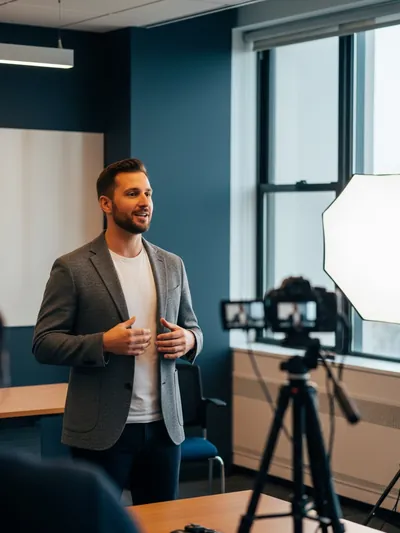
The technique I think helps most is practicing with a video recording device. Your phone works. If you don't have one handy, there is usually one built into your computer or another gadget, and still cameras have them built in too. Do not wait for a studio or a producer.
Here is what you do:
- Run the interview at least one time. Have someone else ask you questions, or pretend someone is asking them.
- Place the device on a shelf or a windowsill so you can speak naturally without holding it, and record the whole run.
- Play it back and look for what is working. Do more of that.
- Pick what you can improve. One or two things, not twenty.
You look for what is working, do more of that, and what can you improve.
Start with what works
Most people jump straight to flaws on the playback. Looking for strengths first tells you what to repeat on the day. In a recent workshop, several people watched themselves and were sure they had come across stiff. The group saw something different: they sounded like an expert, they were relaxed, and they told a story. Without the recording, they would never have known.
The same goes for how you sit and look. People often sit down with a jacket wide open or their legs too far apart, see it on playback, and fix it instantly. Lean slightly forward from the edge of your seat and you usually look great. If you look comfortable, you get credit for being comfortable.
Expect more than one take
Do not expect perfection on the first run. I have been doing this for a few decades and I still record things over and over, different takes. I will say an intro four times and finally get it right and use that one. In a live interview you cannot retake, which is exactly why you use the recording as practice before the real thing and prepare your key line in advance.
If you aren't sure what your best version looks like, put your phone somewhere, say "I need to do that again," and do it again. You are not trying to be a news presenter. You are trying to be you, at your best.
Case study: a practice run on the side of the road
I have run media training for the Colorado Tourism Office many times over the years, and they invited me to speak at their yearly conference, where people from all over the state come to level up their skills. In one session I said that practicing even one time with a video recording device can change your game.
A woman in the audience raised her hand and stood up. She had been in my session two years earlier, and she told the room what happened next.
She was driving when her public information officer called. A print reporter wanted to speak with her, and the reporter wanted to do it right now. She remembered me saying that it is not a big deal to ask for 15 or 20 minutes. So she told the reporter she was driving and wanted to pull off to the side of the road first. The reporter said, no problem at all.
She pulled over and did four things:
- She wrote her core messages on paper.
- She wrote a couple of sound bites.
- She turned on her phone and recorded herself giving the answers she wished she could deliver in the interview.
- She played it back.
The playback let her be objective. She could hear which answers sounded right and which ones needed more work. Then she took a few deep breaths and called the reporter back feeling ready and put together.
Notice that it was a print interview. Nobody was ever going to see her on camera, and the video still helped, because it showed her how her answers sounded. She shared that story with a room of about 300 people, and it carried far more weight coming from her than it ever would coming from me.
Fifteen minutes on the side of the road, one recorded run-through, and she walked into the interview ready.
What to do next
Before your next interview, set your phone on a shelf and do one recorded run-through. If you want a second set of eyes on the playback and a plan for the real thing, get a quick quote.
For related reading, see how to practice with video, not a mirror, how to prepare for a media interview and how to sound confident in a media interview.
How to practice for a media interview: common questions
How many times should I practice a media interview?
At least one full run-through, recorded. If you have time, run it again after fixing one or two things. A second pass with a single adjustment teaches more than a long list of notes.
Do I need a professional camera to practice?
No. Your phone works, and most computers and digital cameras have a video recorder built in. Prop the device on a shelf or windowsill and record yourself answering questions.
Should I prepare answers to every possible question?
No. Spending hours on every last question and every what-if is not helpful and leaves you anxious. One honest look at how you actually come across on a recording is worth more.
What should I look for when I watch the playback?
Start with what is working and plan to do more of it, then choose one or two things to improve. Look at how you sit as well, since leaning slightly forward from the edge of the seat usually looks better than leaning back.
Who should ask me the practice questions?
Someone else if you can, such as a colleague, because it feels closer to the real thing. If nobody is available, pretend someone is asking and answer out loud to the camera.