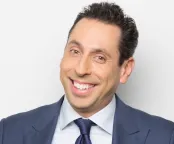

No, the 93 percent body language rule is not true. Dr. Albert Mehrabian's actual research found a 7-38-55 split, 7 percent words, 38 percent vocal tone, 55 percent facial expression, and it applies only to how a listener reads someone's feelings, not to communication or presentations in general. Mehrabian himself calls the broader version absurd.
I sat across from Dr. Albert Mehrabian and asked him, on record, whether the number that built half the public speaking training industry is real. It isn't, not the way everyone uses it. In twenty years of coaching executives I have watched capable people apologize for their hand gestures before a board meeting instead of rehearsing the three sentences that actually mattered. That is what a misquoted statistic does. It sends people fixing the wrong seven percent of the problem.
Why this matters (and what most trainers get wrong)
Type "93 percent body language" into any search bar and you will get a wall of confident slide decks repeating the same broken math. The number comes from adding two of Mehrabian's percentages together, 38 for vocal tone and 55 for facial expression, and applying the sum to public speaking in general. It is a real number attached to the wrong question.
Mehrabian never said that. He said the opposite.
That is Dr. Mehrabian, in his own words, describing the version nearly every presentation coach on the internet still teaches.
I recorded this as audio, not video. Press play and listen, or read the full transcript further down the page.
Audio interview, roughly eight minutes. No video content, just the conversation.
What the 7-38-55 rule actually measured
His study, by his own description, dealt specifically with the communication of emotions, affect, feelings, specifically the moment someone is expressing how they feel about somebody or something. Inside that narrow scope, he combined two separate pieces of research. One measured vocal qualities: speed, volume, hesitation, inflection, the way something is said rather than the words themselves. The other measured facial expression on its own, compared against the other channels.
Here is the detail almost every retelling drops. The percentages describe the listener's side of the equation, not the speaker's. Mehrabian was measuring how much weight a listener or viewer gives to face, voice, and words when reading someone else's feelings, not how much effort a speaker should put into each one.
The 5-step way to correctly apply the 7-38-55 rule
Here is how I actually use Mehrabian's findings with executives now that I've heard the correction straight from him.
1. Confirm you are coaching emotion, not information
Before you spend a minute on posture or tone, ask what the passage is actually doing. Is the speaker stating a fact, a schedule, a number? Or are they expressing how they feel about something? Mehrabian's findings apply to the second case only.
2. Split the channel: face and voice are two different studies
These are not one number split three ways by accident. They come from two separate studies, one on facial expression and one on vocal qualities (speed, volume, hesitation, inflection) that happened to get summarized together. Coach them separately.
3. Remember whose perspective the numbers describe
The weighting describes how a listener or viewer reads someone else's emotion, not how much effort a speaker should put into looks versus content. Almost everyone teaching this rule drops that detail.
4. Borrow his persuasive-speech findings for delivery
For actual delivery coaching, use the other study he handed me: more persuasive speakers had greater variety in facial expression and intonation, spoke faster but not excessively so, and avoided filler sounds and speech errors.
5. Never cut the words
Ask Mehrabian directly whether words still matter and he does not hedge: "They have a tremendous impact. Absolutely." Content is not the 7 percent you can skip.
The mistake most executives (and most trainers) make
He gave me two examples on the spot, and they are the cleanest illustration of the whole rule I have ever heard. First: "If I want to tell you that the book you are looking for is in the upstairs bedroom, in the right hand drawer of my desk, how does a statement like that get to have my findings applied? It doesn't." Same with the yard: "If I say the grass in my yard is too long and I'm going to call the gardener to come and cut it, once again it's the verbal that predominates, it's almost a hundred percent."
Then he flipped it. Same yard, different framing: "If I'm talking about my frustration about the length of the grass, and I'm saying that grass just grows way too much, too often, and I have to keep getting my gardener to come and cut it too many times, then I'm expressing an emotion, and the vocal and facial components come into play."
That is the entire rule in two sentences about a lawn. Content is words. Feeling is face and voice. Most presentations are almost entirely the first kind, and most training treats them like the second.
Case study: coaching the wrong seven percent
I see this pattern constantly. An executive walks into prep already sold on the 93 percent number, usually from a keynote speaker who quoted it as fact, and spends the whole session worried about eye contact and hand gestures. Meanwhile the actual presentation is forty slides of quarterly numbers, a genuinely factual, unemotional briefing where, by Mehrabian's own math, the words are doing almost all the work.
The fix is not to ignore delivery. It's to know where delivery actually earns its keep. When that same executive gets to the two minutes of the deck that are not factual, the part where they talk about a hard year, a layoff, a win the team fought for, that is exactly where vocal variety and facial expression start to carry real weight. Coach the whole deck the same way and you spend your limited rehearsal time on the wrong seven percent of the presentation, over and over.
| The 93% myth | What Mehrabian actually found |
|---|---|
| Applies to communication in general | Applies only to communicating feelings and attitudes |
| 93% body language and tone, 7% words | 55% facial expression, 38% vocal tone, 7% words, and only about emotion |
| Words barely matter | Words carry close to 100% when the content is factual, not emotional |
| Comes from one study | Comes from two separate studies (voice and face) summarized together |
| Measures the speaker's overall impact | Measures how a listener interprets someone else's feelings |
What he told me about persuasive speaking
He also volunteered something most interviewers never think to ask for: hard, practical findings about what actually makes a speaker persuasive, not just likeable. From a study his team ran back in the 1970s, the pattern held across the more persuasive speakers he measured. They showed greater variety in facial expression and vocal intonation. They spoke faster than average, not excessively so, just faster. And they cut out filler sounds and verbal stumbles almost entirely. None of that is about looking a certain way. It is about doing something specific with your face, your pace, and your mouth's bad habits.
The full transcript: my conversation with Dr. Albert Mehrabian
Here is the conversation itself, lightly cleaned for punctuation and readability, word for word otherwise.
Jess Todtfeld: I'm with Dr. Albert Mehrabian, who many know as the originator of what is sometimes called the 7-38-55 rule, or 55-38-7 depending on your circle. Dr. Mehrabian, thank you for joining me.
Dr. Albert Mehrabian: You're welcome. I appreciate it.
Jess Todtfeld: Now, this is a very misquoted rule, and I appreciate you taking time out to make sure we are on the right track.
Dr. Albert Mehrabian: Yes, I agree. My findings have been overgeneralized over the decades.
Jess Todtfeld: Please set us straight. Tell us exactly what the study was, and what we should be saying if we want to say the right thing in front of a group.
Dr. Albert Mehrabian: My study dealt specifically with the communication of emotions, affect, feelings. It was when people are expressing how they feel about somebody or something, and within that context I summarized the findings from two separate studies. One of them dealt with voice and the vocal qualities of speech. By vocal I mean the speed with which we talk, the volume of our voice, the amount of hesitation, inflection, all of those features of the way in which we say things that convey emotion. So we have the words, then we have the way we express those words, that can make a big difference in the emotions that are conveyed. And then in a separate study I looked at facial expressions and compared them to the other components of communication. Again, my intent was to study communication of emotions, and the equation that I supplied was to roughly summarize how much people weight face versus vocal characteristics versus words when they are communicating their emotions. The findings are from the perspective of the listener, the viewer. The viewer or listener tends to emphasize facial expressions the most, then the vocal characteristics of the speech, and finally the words. That, in a nutshell, is the essence of my findings. Unfortunately, a lot of people, I don't know what their reasons are, decided to overgeneralize my findings and make them sound as if they were for communication in general, which would be absurd. I can give you many examples to show how absurd it would be to make that contention for general communication.
Jess Todtfeld: Right. A lot of times, people who teach public speaking apply this to public speaking. So when you say communication, tell us what you mean. Are we talking about a conversation, on a stage, a job interview?
Dr. Albert Mehrabian: It can be any of those. It could be a personal encounter with a friend or a loved one, it could be a more formal setting such as a lecture, or it could be a TV broadcast or a lecture via some kind of internet medium, telephone communication, any of those. And when you have these various features of communication present, of course on the telephone you're not going to have the visual signals, but you still have the vocal and the verbal.
Jess Todtfeld: And you said your intent was communicating emotion. So I think some of the issue is people who are teachers or coaches or public speaking trainers generalize this as the impact that a speaker has in front of an audience, that it comes down to 55 from body language, 38 vocal, and 7 for the words. And you're saying that's an overgeneralization. If we use the word impact, it had to do more with how we're communicating our emotion, am I right?
Dr. Albert Mehrabian: Right. In other words, if a speaker is telling his audience, 'I had a very good time during our session today, I enjoyed your questions, this was a very pleasant environment in which we interacted,' if the speaker is addressing those kinds of issues then obviously my findings come into play. But if the speaker is talking about some abstract subject, say math, describing a mathematical equation and saying x plus y equals z, there is no way in which the facial expression or the voice is going to contribute to the interpretation of that equation.
Jess Todtfeld: Right. And I think you really said it today in the best way I've heard, since it was your studies that led to us finding out this information, where you just said it has to do with communication of emotions. It's not the impact that a speaker makes on an audience.
Dr. Albert Mehrabian: Not impact. It's just communicating emotion. That is a different conversation.
Jess Todtfeld: Right. And I would love it if you gave those examples, just to solidify.
Dr. Albert Mehrabian: Okay, here's an example. If I want to tell you that the book you are looking for is in the upstairs bedroom, in the right hand drawer of my desk, now how does a statement like that get to have my findings applied? It doesn't. Or if I say the grass in my yard is too long and I'm going to call the gardener to come and cut it, once again it's the verbal that predominates, it's almost a hundred percent. Now, if I'm talking about my frustration about the length of the grass, and I'm saying that grass just grows way too much, too often, and I have to keep getting my gardener to come and cut it too many times, then I'm expressing an emotion, and the vocal and facial components come into play.
Jess Todtfeld: Fantastic. And this is the part I'd love to end on. Thank you, by the way, for setting us straight. We want to get things right as communicators who are up in front of many others and helping them. We don't want to spread the wrong information. So for all the work that you've done your entire life, are you still teaching?
Dr. Albert Mehrabian: Oh no, I'm retired from UCLA. I was a professor.
Jess Todtfeld: And you've been retired for how long?
Dr. Albert Mehrabian: Oh, I really retired in '97, but I kept doing my research and so forth until the early 2000s.
Jess Todtfeld: So this is the last question. For public speakers, people who are either professional speakers, and even people who are just getting up in front of people, of all the research that you've done, what advice would you like to give when it comes to making an impact?
Dr. Albert Mehrabian: Well, I have a study that we did back in, I believe, the '70s regarding how a person can be persuasive in the manner in which they speak, and I'll briefly state the findings. The more persuasive speakers tended to have greater variety of facial expressions and intonation, they spoke faster, not excessively fast but they spoke faster, and they did not have speech errors in their speech, things like, you know, 'aha,' things like that. And those findings are summarized in a very extensive study.
Jess Todtfeld: I really do appreciate it.
Dr. Albert Mehrabian: Okay, now while we're at it, if you are going to bring up politics and political campaigns, I'm also going to include an article that we did on deceptive communication.
Jess Todtfeld: That would be wonderful.
Dr. Albert Mehrabian: It always amazes me that when they figure out what percentage of lying takes place with various politicians, and they say, 'well, this one's not too bad, it's only 25 percent of the time,' that still seems too high to me.
Jess Todtfeld: That's a whole other area. Yes, I'd be happy to read some of your other work.
Dr. Albert Mehrabian: It's just a matter of taking a look at the nonverbal components of their communication and seeing whether they're trustworthy or not.
Jess Todtfeld: And words still matter, right? As kind of a little ender.
Dr. Albert Mehrabian: Oh, they have a tremendous impact. Absolutely.
Dr. Albert Mehrabian was a professor at UCLA. He retired from teaching in 1997 and continued his research into the early 2000s. During our conversation he pointed me to his own catalogue of books, which you can find on his Amazon author page. If you take one thing from this piece, let it be that: go to the source rather than the slide deck quoting the source.
Common questions about the 93 percent body language rule
Is the 93 percent body language rule true?
No. It comes from adding two of Mehrabian's percentages together, 38 for vocal tone and 55 for facial expression, and applying the total to communication in general. Mehrabian's actual research covered only how listeners read someone's emotions, and he has called the broader claim absurd.
What is the real 7-38-55 rule?
Mehrabian's research found that when people judge someone's feelings about a topic, they weight facial expression at 55 percent, vocal tone at 38 percent, and the actual words at 7 percent. It applies only to communicating emotion, not to communication as a whole.
Does body language really account for 93 percent of communication?
No. No study, including Mehrabian's, ever measured general communication as one category. His numbers come from two separate studies, one on voice and one on face, about emotional expression specifically. Adding 38 and 55 to get 93 percent and applying it to all communication is a misreading Mehrabian has directly disputed.
If the 93 percent rule is wrong, do words matter in a presentation?
Yes, often almost entirely. Mehrabian's own examples, telling someone where a book is, or announcing you are calling the gardener, are close to 100 percent verbal. Vocal tone and facial expression only carry real weight once the content turns emotional.
What did Mehrabian say makes a speaker more persuasive?
In a separate study from the 1970s, he found more persuasive speakers used greater variety in facial expression and intonation, spoke faster than average without rushing, and avoided filler sounds and speech errors.
Why do so many public speaking trainers still teach the 93 percent version?
It is simple, dramatic, and rarely checked against the original research. Mehrabian's actual findings are narrower and less quotable, which may explain why the oversimplified version spread while the correction did not.
What to do next
If you coach executives on delivery, the fix is simple. Stop treating every slide the same way. Content gets rehearsed as content. The handful of moments that are genuinely emotional, the ones about people, stakes, or change, are where vocal variety and facial expression are worth real rehearsal time.
That is the exact split I build into high-stakes presentation training: know which seven percent, or which fifty-five, actually needs the work. If you want a program built around your next high-stakes presentation instead of a generic module, get a quick quote and we will map it to what you are actually walking into. You might also want executive presentation training for the delivery side of this.