
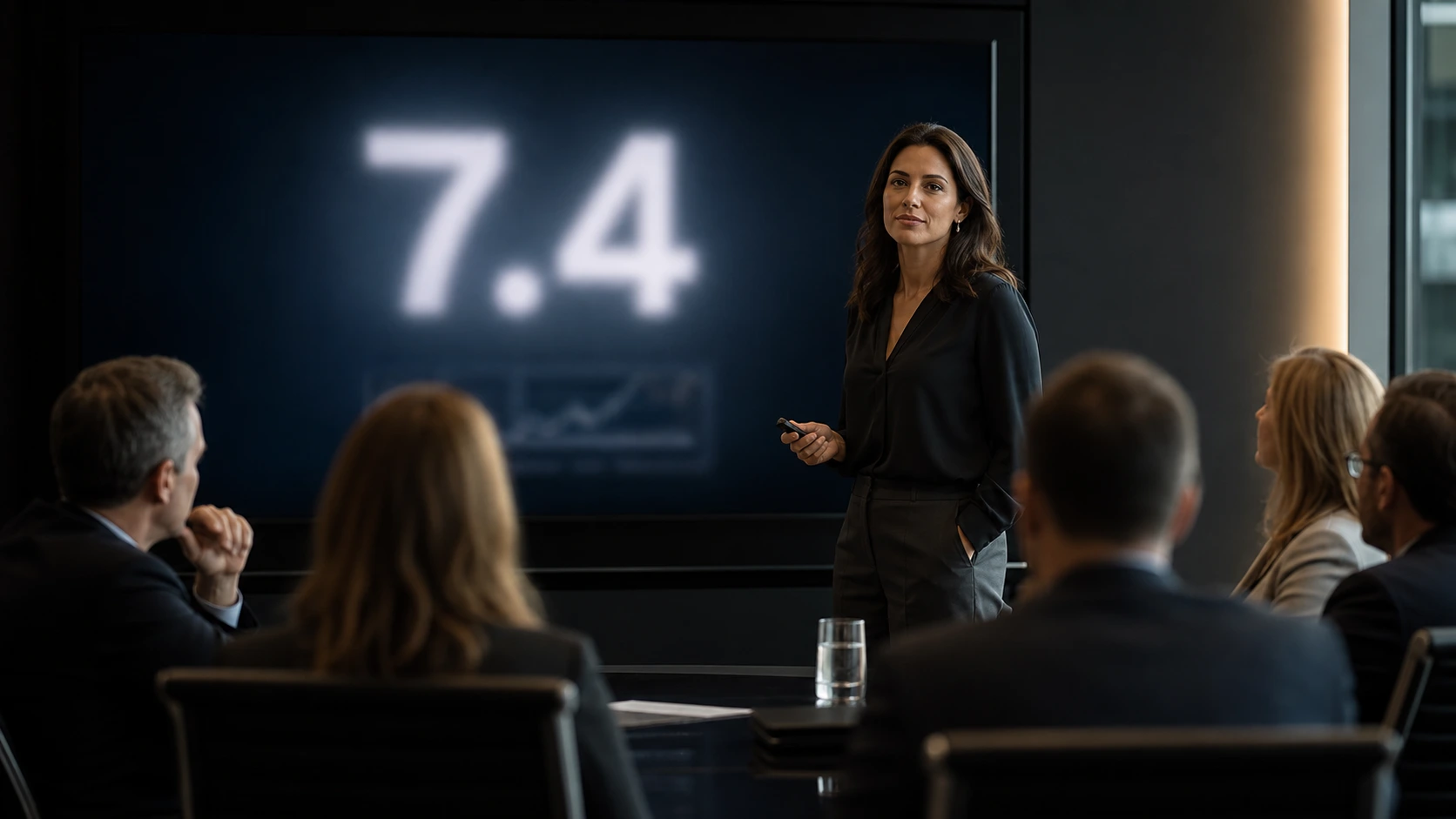
Presentation aids (like PowerPoint) reduce apprehension in three specific ways: they move the room's eyes off you for a moment, they hold your structure so your memory does not have to, and they give you a fixed place to return to when you lose your thread. What they cannot do is make you feel calm. That comes from somewhere else, and it is the part almost nobody gets told.
I coach a version of this person constantly. Recently promoted, technically excellent, now expected to stand in front of a room of people more senior than they are. They tell me the same things in the same order: the heart goes, the breathing goes shallow, the words stack up and come out in the wrong order. They have the ideas. They cannot get them out of their mouth.
And every one of them asks about slides. Will slides help?
Why this matters (and what most executives get wrong)
Yes, slides help. Just not for the reason people hope.
The hope is that the aid will absorb the attention permanently, that if the deck is good enough nobody will really be looking at you. (Especially when virtual and hidden in a postage stamp sized window.) That is not how a "room" works, and chasing it produces the densest, ugliest, most read-aloud decks I see. The audience looks at the screen, gets bored, and looks back at you anyway, except now you have lost the room and you are still nervous.
Here is the mechanism that actually works. Communication apprehension spikes hardest in two places: the opening thirty seconds, and any moment you feel your structure slipping. An aid can absolutely help with both. A first slide gives the room something to land on while you get your first breath. A clear structural slide means that when your mind goes blank, the next idea is already on the wall in front of you. You are not remembering. You are reading a signpost and continuing.
That is real relief, and it is worth engineering. It is also a fraction of what people expect from it.
The 5-step way to use presentation aids to reduce apprehension
1. Give the room something to look at in your first ten seconds
The opening is where apprehension peaks. Put one simple, visual thing on screen as you begin: a single image, one number, a six-word line. The room's attention goes there for a beat, and that beat is where your breathing steadies. Do not open on an agenda slide. Nobody has ever calmed down while reading an agenda.
2. Make each slide carry the structure, not the script
One idea per slide, stated as a claim you would actually say out loud. "Costs rose in Q3" is a signpost. A slide with nine bullets is a script, and the moment you start reading it your voice flattens and the room checks out. If you want the full argument for this, I made it in one idea per slide. The apprehension benefit is direct: a signpost tells you where you are without asking you to perform from memory.
3. Build one recovery slide and know where it is
Somewhere in the middle, put a slide that restates the whole argument in a sentence. That is your recovery point. If you lose your place, you advance to it, say the sentence, and you are back on rails. Just knowing it exists lowers the fear, because the worst-case scenario now has a floor. I have watched people relax visibly when they realize they have a way out.
4. Rehearse standing up, out loud, with the aids you will actually use
Reading through your deck at your desk is not preparation. It is reassurance. Stand up, click through the real slides on the real screen, and say the words at full volume to an empty room. Two reps. Almost everyone discovers on the first rep that a transition they thought was smooth is not, and that is a much better place to discover it. There is more on how to structure that work in how to practice a presentation.
5. Record one run and watch it back
This is the step people skip, and it is the one that does the heavy lifting. Set a phone on a shelf, run the presentation, and watch the recording. Do it before you decide how nervous you look.
The mistake most executives make
They use the visual aid as a hiding place, and it costs them twice.
In the short term it feels like relief. More words on the slide means less to remember, and less to remember means less to fear. So the deck fills up. Then, on the day, you turn toward the screen and read, and you can feel the room's energy drop, and that drop makes you more anxious, not less. The thing you built to protect you is now the source of the pressure.
The second cost is longer. Every presentation you get through by reading is a presentation where you never found out you could do it without the crutch. The apprehension never gets disconfirmed. It just gets managed, over and over, for years. I have coached people fifteen years into a career who are still exactly as frightened as they were at the start, because nothing ever proved to them that the fear was overestimating the danger.
The gap between how anxious you feel and how anxious you look is enormous, and it runs in your favor almost every time. Racing heart, shallow breath, the certainty that everyone can see it: none of that shows up on the recording the way it does in your body. You look composed. You just cannot feel composed from the inside.
Case study: the leader who thought everyone could see it
An anonymized example, drawn from a pattern I see constantly rather than from one person.
A newly promoted leader in a technical field has a short presentation coming up in front of a room of senior colleagues, and not much time to get ready. The symptoms are physical and familiar: heart pounding, breath going shallow, words arriving in the wrong order under pressure. The self-assessment is brutal. They are convinced they come across as visibly panicked, and they have started avoiding the kind of visibility the new role requires.
So we record one run. Nothing fancy, ten minutes, one camera.
Then we watch it together, and the same thing happens that happens nearly every time. The person on the screen looks fine. Not perfect, fine: composed, credible, a little fast in places, entirely in control to anyone who is not living inside that body. There is usually a long pause when they see it. Sometimes an argument. "That is not what it felt like." Correct. It never is.
From there the work gets easy, because the fear has lost its evidence. We do more reps, we cut the deck down to signposts, we build the recovery slide, and each round we watch a recording that keeps disagreeing with the catastrophe in their head. That is the whole method: not talking someone out of their apprehension, but showing them the recording until the recording wins.
I have seen the same reversal with people facing very large audiences, which is supposed to be the harder case. It is not, particularly. The number of people in the room changes almost nothing about the mechanics. It changes what you imagine they can see.
Where presentation aids reduce apprehension, and where they do not
| Aids genuinely reduce this | Aids do not touch this |
|---|---|
| The blank-mind risk, by holding your structure on the wall | The physical response: heart rate, breath, dry mouth |
| Opening exposure, by giving the room somewhere to look | Your belief about how you come across |
| The fear of getting lost, if you build a recovery point | Fear of a question you did not anticipate |
| Cognitive load, by carrying the numbers you would otherwise memorize | Anything at all, if the aid becomes a script you read |
The right-hand column is the actual work. Reps close it. Recordings close it faster.
What to do next
If you have something coming up, do the cheap version this week: cut every slide to one idea, add a recovery slide in the middle, and run it standing up twice. Then record one run on your phone and watch it before you decide how you looked. (Secret: Your old deck is still great as a handout.)
If the apprehension is bigger than a single presentation, that is a different project, and it is a solvable one. This piece on presentation nerves covers what to do in the hour before, and high-stakes presentation training is the structured version, built around recorded reps and immediate feedback rather than around your slides.
If you want a straight answer on what that would take, get a quick quote and tell me what you are walking into.