Updated
Quick answer: Ask good podcast questions by doing your homework first, then hunting for "the wow," the one surprising thing your audience would want to hear about. Use AI tools for research, skip the lazy "tell us about yourself" opener, ask open-ended questions, and hold a five-minute pre-interview so you know where the conversation is going.
If you host a podcast that features guests, your questions are the show. The audience is not there for your microphone or your intro music. They are there for what the guest says, and what the guest says depends almost entirely on what you ask. After 13 years as a national TV producer, I can tell you the strongest interviewers are rarely the cleverest. They are the best prepared, and they know exactly what they are hunting for.
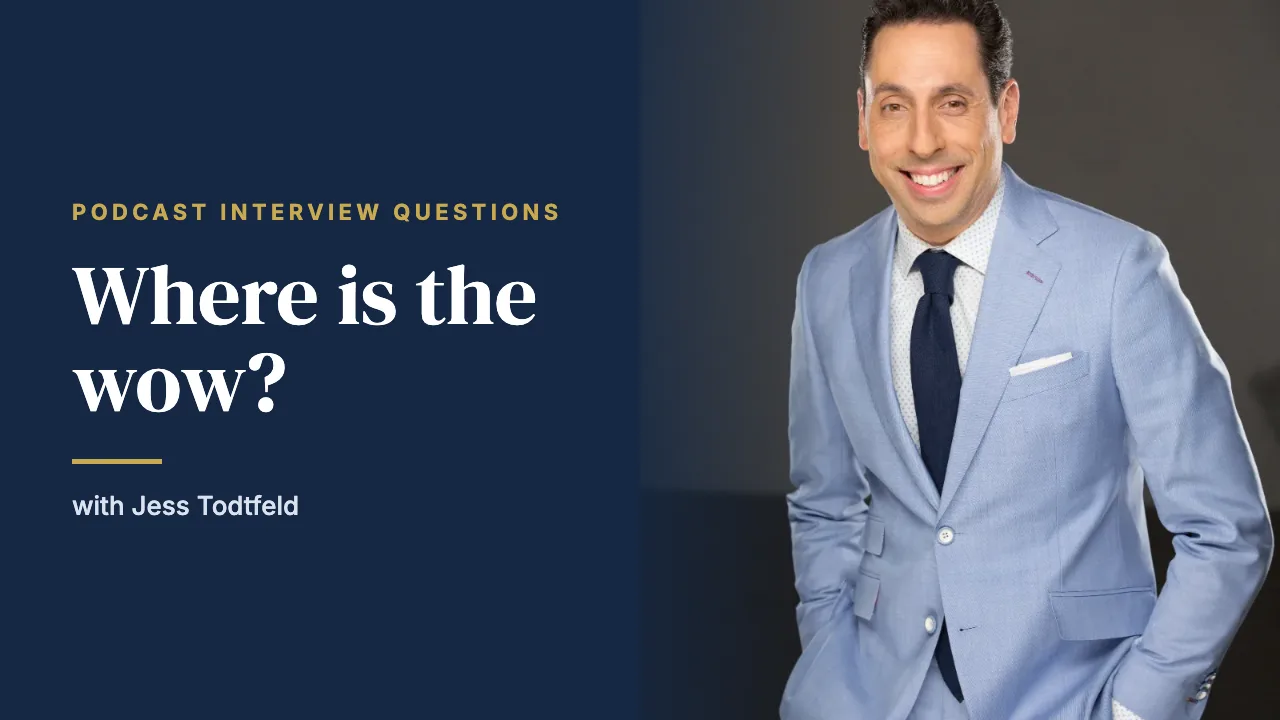 Play the video: How to have interesting podcast questions: where is the wow?
Where do you start when writing podcast interview questions?
Start with homework. If you are interviewing someone, you have to learn a little about them before you sit down. I like to begin with my own brain. I look at the guest's website and ask what the audience would want to know. Then I ask the question that matters most to me: where is the wow?
The wow is the thing that makes you and your audience say, "I didn't know that. Tell me more." It is the surprising detail, the unexpected result, the story that does not fit the guest's usual bio. I like to start the interview there, with the most exciting thing, for a simple reason. The audience thinks, "If the rest is as interesting as this, what else is coming?" You raise the bar for yourself and for the guest in the first minute.
If you host a solo show where you speak straight to camera, the exercise still applies. You are just asking the questions of yourself. Where is the wow in this topic? What would make a listener lean in?
How can ChatGPT or Claude or Perplexity help you research a guest?
AI tools are a genuinely good way to build a first list of questions, and the two I use most are ChatGPT and Claude. After a certain number of searches, ChatGPT can drop you down to an older model. Perplexity lets you do quite a lot before it asks you to pay. I pay for both ChatGPT and Claude because I use them heavily, so decide for yourself how much you will use them.
Give the tool as much as you can. Tell it who you are interviewing, paste in the guest's website address, add anything else you already know, say how long the interview will run, and describe the angle of your show. Then ask for 25 questions you could ask. You can also ask what the most surprising thing about this person is, or how the guest fits the topic of your podcast. A quick back and forth can produce questions you would never have thought of alone.
Here is a real example. I trained a client who had been a Nickelodeon TV star, and I had not seen all of the Nickelodeon shows. I put the situation into ChatGPT, and it gave me questions about what was happening in the Nickelodeon universe, including a moment where kids were shocked at something this person had done. I never would have found that on my own, and it made it look like I had done serious research.
One caution: double check anything that does not sound right. Both tools now tell you where they found the information, so click the sources. Occasionally the source is old, or it leads to a "404 not found." Treat the AI as a starting place, not a final answer.
Should you read your questions during the interview?
Use them to come up with ideas, then run the conversation. Ideally, you are not staring at your list. If you record on a webcam, you can put the questions on your screen or print them out and place them where you can glance at them. Paper has a small advantage: it cannot accidentally close or go down. But you also do not want to be shifty-eyed, flicking between the guest and your notes.
That is why I treat the list as raw material. Once you have thought through the questions, you can get into a flow and respond to what the guest actually says. It takes a little practice, so do not worry about it. You will get better at it quickly.
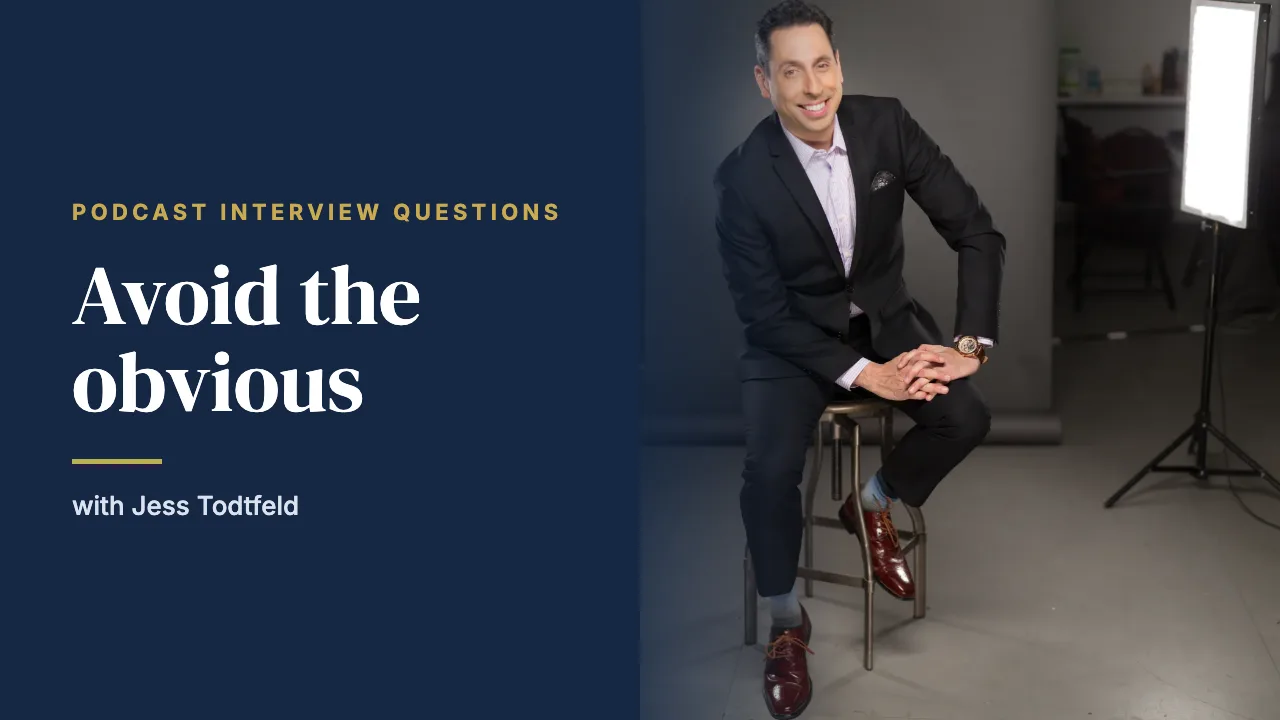 Play the video: More on podcast interview questions: avoid the obvious
Which podcast interview questions should you avoid?
Avoid the obvious. You have probably heard this opening: "Joining me today is a financial advisor and an expert in her field. Welcome. Tell us a little about yourself." And the guest answers, "Thank you so much for having me to speak with you and your audience."
To me, that is a lazy interviewer who has not figured out what the guest is about and is really saying, "You explain it. I don't know why I invited you." You would never see that in a higher level TV interview. Look like you know who the guest is. Share with the audience why you wanted this person on and why it matters to them, then go straight to the wow. You do not need to read their bio aloud.
Why use open-ended questions?
Open-ended questions invite stories. "Tell me about a time when this happened" and "How did you handle that challenge?" can take the guest in a number of directions, and that is where the interesting material lives. A question that can be answered with yes or no gets you a yes or no.
Open questions can wander, though, and there is a way to rope them in.
What is a pre-interview, and why hold one?
Talk to the guest for about five minutes before you record. It can happen anywhere, but I am thinking about your time and theirs, so keep it short. Tell them how you envision the interview going. Say, "I noticed on your website that you talk about this. It is a chance for you to cover it. Then I will probably ask about these other things."
The guest can tell you whether you are on the right track, or add, "Here is something else your audience might want to know." When that happens, write it down. A pre-interview means you know you are headed in the right direction before the recording starts, and you are several steps ahead.
Putting it together
- Research the guest yourself, then use an AI tool for a longer list, and verify the sources.
- Find the wow and open with it.
- Skip the "tell us about yourself" opener and the bio read.
- Choose open-ended questions that invite stories.
- Hold a five-minute pre-interview so the guest knows what is coming and can add what you missed.
Everything above is about the interviewer's side of the microphone. If you want to see how the other side thinks, what journalists are thinking in an interview is a useful read. When your questions are ready, run through the podcast hosting checklist so the setup is as ready as the questions are.
Want to sound like a pro on camera while you host? Learn about on-camera training or get a quick quote and we will shape a session around your show.