
To improve your speaking voice, start by hearing it accurately, which you cannot do while you are talking. Record two minutes on your phone, play it back, change exactly one thing, and record again. Almost every voice problem I see in training is invisible to the person who has it, and becomes obvious the moment they watch the recording.
There is a moment in nearly every training session I run. We record someone answering a question they have answered a hundred times, then we play it back, and about eleven seconds in they say something like "oh." Not "oh no." Just "oh." That is the sound of a person hearing themselves for the first time.
Nothing I say in the previous hour does what those eleven seconds do.
Why can you not hear your own voice?
Two reasons, and they stack.
The first is physical. When you speak, you hear yourself partly through the air and partly through the bones of your own skull, which adds a low warmth that no microphone captures. The recording is not distorting you. It is the version everyone else has always heard. That gap is why so many people wince at their own audio and conclude something is wrong with their voice.
The second reason matters far more, and it has nothing to do with acoustics. While you are speaking, you are busy. You are managing nerves, watching the room, and running one sentence ahead to work out what comes next. There is no spare attention left to audit your own delivery. As I put it to a voice coach recently, people are simply too close to it, because they are inside their own body.
So you end up with a strange situation. The one skill you use in every meeting is the one skill you have almost no accurate feedback on.
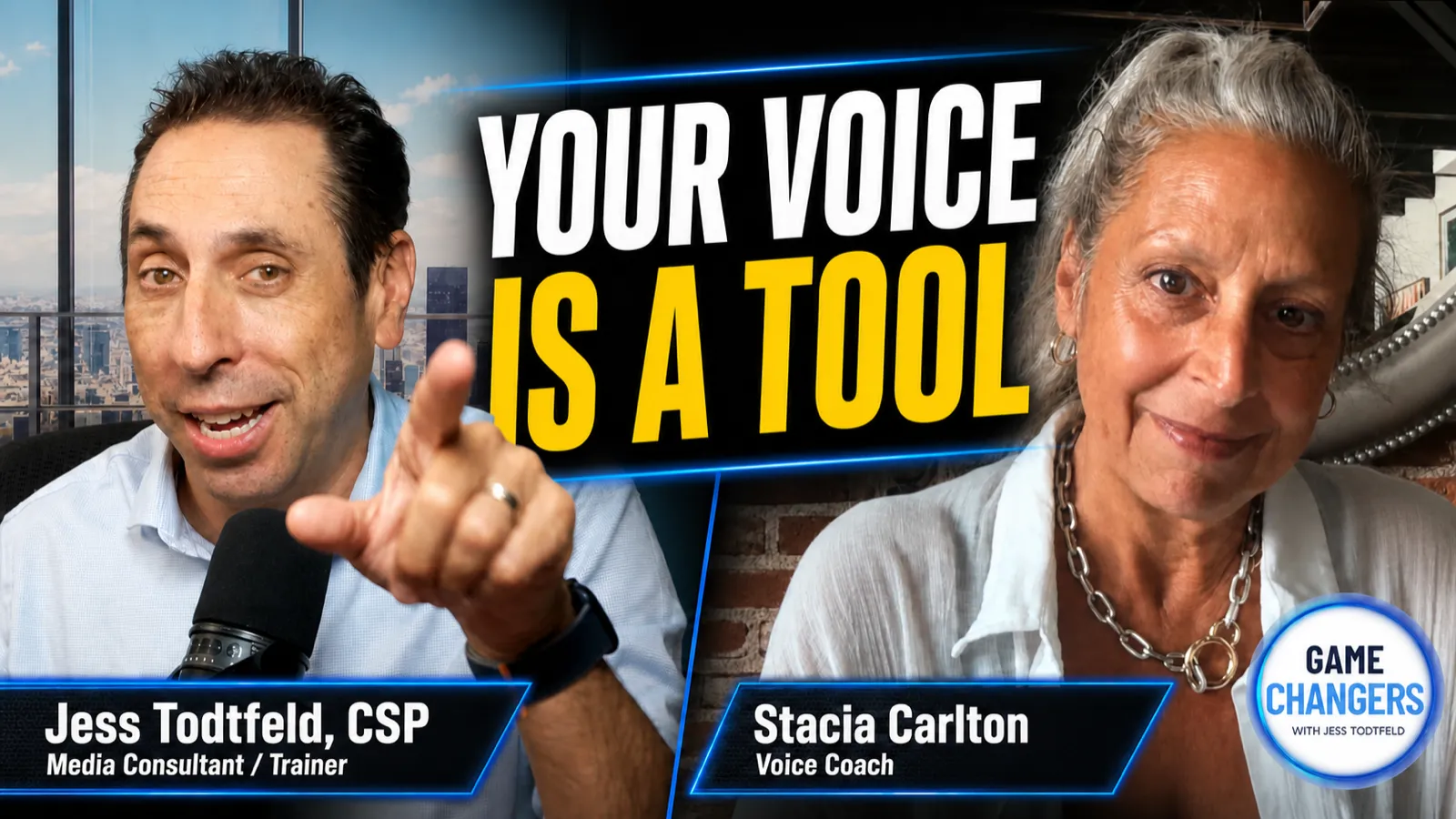
Voice coach Stacia Carlton on what she hears that speakers cannot. Watch the conversation.
What actually changes when someone watches the recording
Over twenty years and more than five hundred executives, the same three things surface on playback, and none of them is the thing the person asked me to fix.
- They are faster than they think. Every single time. Nobody has ever watched themselves back and said "I was speaking too slowly."
- They are flatter than they think. Energy that felt like enthusiasm from the inside reads as neutral from the outside. The gap is usually about thirty percent.
- They are hedging. Qualifiers, restarts, and half-sentences that they did not know were there, because the thought was still assembling as they spoke.
Notice that none of those is the sound of the voice. They are behaviors. That distinction is the whole game, because behaviors are trainable in an afternoon and vocal anatomy is not trainable at all.
The thing a person asks for help with is usually adjacent to the real problem, but it is not the problem. Someone asks me how to stop saying um. What they actually need is to become comfortable with one second of silence, because the filler is only there to cover a pause they cannot yet tolerate. Fix the tolerance and the um disappears on its own.
The two-minute loop
You do not need a studio, a coach, or a course to start. You need a phone and the willingness to be mildly uncomfortable for a week.
- Record two minutes. Answer a question you get asked constantly. Do not script it. Scripted delivery hides the exact habits you are trying to find.
- Watch it once for pace only. Ignore how you look. Ignore the sound of your voice, which is a separate and largely irrelevant reaction. Mark the places you did not breathe.
- Change one thing. One. If you try to fix pace and energy and filler words at once you will fix none of them and conclude you are hopeless.
- Record again. Same question, one variable changed.
The one-thing rule is the part people skip, and it is the part that makes this work. A speaker juggling four corrections sounds like someone juggling four corrections. A speaker who has genuinely fixed their pace sounds like a different person.
What I learned recording my own audiobook
For my last media training book I insisted it had to be me reading the audiobook. Who better, I thought. I know the material, I have spent a career in front of microphones, and I hold a world record for giving 112 media interviews in twenty four hours. How hard could a few hours of reading be.
Three chapters in, I realized it did not need to be me at all.
Not because I could not do it. Because it is exhausting in a way that has nothing to do with whether you can read out loud well. Sustained vocal work is physical labor, and being comfortable on camera does not transfer to it any more than being a good driver transfers to racing. That was a useful thing to learn about the limits of my own instrument, and it made me a lot more precise about what I ask executives to do in a long day of sessions.
What not to work on
A short list, because chasing these wastes the time you should be spending on pace.
- Your pitch. Forcing your voice lower produces a strained, pushed sound that listeners read as effort, not authority. Slow down instead and pitch settles into its natural range by itself.
- An accent. I have never once seen an accent be the actual barrier. Clarity is the barrier, and clarity is about pace and phrasing.
- Sounding like a broadcaster. Audiences are extremely good at detecting a performance. A performed voice costs you more credibility than an ordinary one ever did.
If your voice tires during heavy speaking weeks, that is a genuinely different problem with a genuinely different fix, and voice coach Stacia Carlton covers the maintenance side well in our conversation about clarity.
How long before it sticks?
Faster than people expect, because you are changing behavior rather than anatomy. In a focused session I can usually get a measurable difference inside an hour. Making it permanent takes a few weeks of the two-minute loop, because the goal is not to perform well once. It is to make the new pace feel normal so it survives the moment your adrenaline spikes.
That last part is why people who only rehearse never improve. Rehearsal in a calm room teaches you nothing about what you do when the stakes arrive. The recording does.
Once your pace is under control, the next two levers are how to slow down when speaking and why your tone of voice matters. If you speak on camera, how to control your voice on camera covers the nerves layer.
If your team has a high-stakes moment coming and you would rather not leave the delivery to chance, tell us what is coming up. An afternoon of playback changes more than a year of advice.