
To speak more clearly, slow down further than feels natural, know your own point before you open your mouth, and breathe where the commas are. Clarity is almost always a timing problem rather than a tone problem. Most people who dislike the sound of their own voice are really hearing pace and phrasing, and both are fixable.
Ask a room of executives what they would change about the way they speak and most of them will say something about the sound of their voice. Too high. Too thin. Too flat. Too something. Almost nobody says "my pacing is wrong" or "I do not phrase my thoughts before I say them," which is the actual problem in nearly every case.
I recently sat down with voiceover artist Stacia Carlton, who records corporate, e-learning, documentary, and museum work, including audio guides you can hear in museums overseas. She spends her working life inside the one skill most professionals only think about right before a big presentation. What she said about this gap was the sharpest version of it I have heard.
Why does everyone think their voice is the problem?
Carlton described the reaction she gets the moment people learn what she does. "It is almost like when you find out you are talking to a hairstylist and you are checking your hair," she said. People become instantly self conscious about a thing they had not thought about all day.
And underneath that reflex is a real worry. "For the most part, people really do not like their voice," she said, "and I think they feel that it impacts their ability to communicate their message."
That fear is reasonable. The conclusion drawn from it is wrong.
This matches something I see in media training constantly: the thing a person asks for help with is adjacent to the real problem, but it is not the problem. Someone asks me to make them sound more authoritative. What they actually need is to stop cramming three ideas into one breath. Fix the pacing and the authority shows up on its own, without anyone touching their pitch.
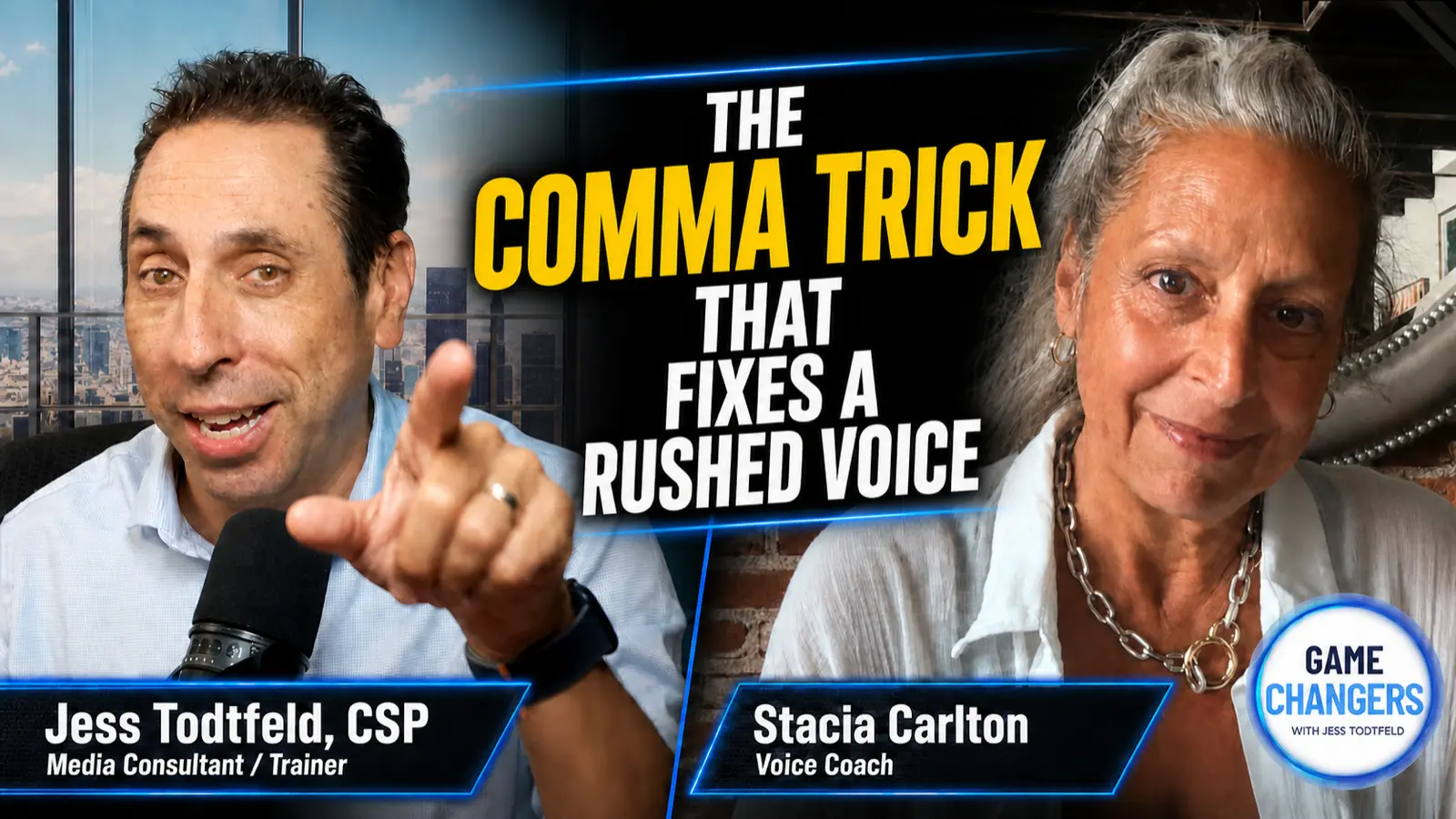
Stacia Carlton on why clarity and timing beat tone. Watch the full conversation.
What actually makes speech unclear?
Two things, in the order that matters.
First, not knowing your own point. Carlton's preparation starts before any sound comes out. "Being very clear and understanding the message that is trying to be communicated," she said. "If I understand what my client is trying to say, not simply the words on the page but truly what their message is, I will be able to better communicate it."
That distinction, the words on the page versus the message, is the whole thing. A speaker who has not decided what they are actually saying will hedge, restart sentences, and pile on qualifiers. Listeners hear that as mumbling or as a weak voice. It is neither. It is unresolved thinking arriving in real time.
Second, speed. Carlton's simplest fix, and the one she admits she needs herself: "Everyone rushes. I am certainly guilty of it in a social setting, I can talk a million miles an hour. But when you are trying to communicate, lower your voice a little and slow down."
Rushing is what turns clear thoughts into unclear speech. Consonants get clipped. Sentences run together. The listener spends their attention on decoding instead of on agreeing with you.
How do you slow down when you have talked fast your whole life?
You do not slow down by deciding to slow down. That lasts about nine seconds. You slow down by changing something structural, and the most reliable structural change is where you breathe.
Carlton's answer here was the most practical thing in the entire conversation, and it is almost embarrassingly simple.
Breathe at the commas. "Commas are there for a reason," Carlton said. "That is where we breathe, and it allows our thoughts to expand a little bit." Print what you plan to say, or just say it out loud, and treat every comma as a real breath rather than a punctuation mark you speed past.
Here is why this works better than "add pauses." Telling a nervous speaker to pause is asking them to invent silence, and silence feels dangerous when you are already anxious. Nobody knows how long a pause should be. But everybody knows where a comma goes. You have known since grade school. You are not learning a performance skill, you are following punctuation you already understand.
The pauses arrive anyway. You just did not have to manufacture them. If pace is your main issue, I go deeper on it in how to slow down when speaking.
What is the difference between sounding excited and sounding excitable?
This was Carlton's second principle, and it is a distinction most people have never had named for them. "There is a difference between being excited about your subject and sounding excitable," she said. "You do not want to sound excitable."
Excited is engagement. Your energy is pointed at the material. Excitable is volatility. Your energy is pointed at nothing in particular, and it reads to a listener as nervous rather than passionate. The tell is usually pitch that climbs through a sentence and never comes back down, paired with a pace that accelerates the more interested you get.
The fix is not to flatten out. A flat read is its own failure, and Carlton is blunt about it: "I can sit here and just read from the page, and it means nothing, and it sounds like nothing, and your entire audience will drift." The fix is to keep the energy and take back the tempo. More on this in why your tone of voice matters.
What people ask for, and what is actually wrong
After twenty years of these conversations, the requests fall into a short list, and the gap between the request and the diagnosis is remarkably consistent.
| What they ask for | What is usually happening | What fixes it |
|---|---|---|
| "I need to sound more authoritative" | Three ideas crammed into one breath | One idea per sentence, breathe between them |
| "I mumble" | The end of each sentence is rushed and dropped | Finish the last three words at full volume |
| "My voice is too high" | Speed is pushing pitch upward | Slow down; pitch settles on its own |
| "I lose people halfway through" | No landing points, so nothing is signposted | Pause after the point, not before it |
| "I ramble" | Thinking is still happening out loud | Decide the one sentence before speaking |
Not one of those fixes involves changing how a voice sounds. Every one of them is a timing or structural change, which is precisely why clarity is trainable and why it moves faster than people expect.
What being unclear actually costs
It is tempting to file this under polish, something to get to after the real work. That underrates it badly, because the cost does not show up as bad feedback. It shows up as things quietly not happening.
Decisions get deferred, because a room that is not sure what you meant will not commit. Your idea gets re-explained by someone else later and lands better, and you never quite work out why. Questions come back that you already answered, which reads to everyone else as though the answer was not solid. None of that arrives labelled as a communication problem. It just looks like slow progress.
The uncomfortable part is that the clearest person in a meeting is very often not the one with the best analysis. They are the one whose analysis survived the trip across the table intact.
A two-minute test that does not involve recording yourself
Recording yourself is the most reliable diagnostic, and it is covered in how to improve your speaking voice. But there is a faster test that costs nothing and works in a live conversation.
Explain something to a colleague, then ask them to say it back to you in one sentence. Do not coach them. Whatever comes back is what you actually communicated, as opposed to what you believe you said. If they hand you three sentences, or the wrong emphasis, or a hedge you did not intend, the problem is upstream of your voice.
Most people find the gap alarming the first time. That reaction is useful. It relocates the problem from "how I sound," which is largely fixed, to "how I structured that," which is entirely within your control and fixable this afternoon.
Does any of this require changing how your voice sounds?
No, and this is the part worth internalizing if you have ever recorded yourself and winced.
Every fix above is mechanical. Understand your message. Slow the tempo. Breathe at the commas. Keep energy without volatility. Not one of them asks you to lower your pitch, add gravel, or perform a voice that is not yours. The people who try to solve clarity by manufacturing a "radio voice" usually end up sounding less credible, not more, because now the audience is listening to a performance instead of a person.
Your voice is not the problem. What you are doing with it is. That is good news, because behavior is far easier to change than anatomy.
How long does it take to speak more clearly?
Faster than most people expect, because the changes are behavioral. In a training session I can usually get a measurable difference inside an hour, and the reason is not talent. It is that people cannot hear themselves accurately while they are talking. You are inside your own head, listening through your own skull, managing your nerves. That is why coaching works: someone outside your body tells you what actually landed.
Record yourself for two minutes on your phone this week, answering a question you get asked all the time. Listen once for speed. Listen again for whether you knew your point before you started. Almost everything you want to fix will be in one of those two passes. Then keep going with how to improve your speaking voice, and if you speak on camera, how to control your voice on camera.
If your team has a high-stakes moment coming up and the message has to land clearly the first time, tell us about it here. One focused session on pace and phrasing changes how a room hears you.
Quotations from voiceover artist Stacia Carlton come from a recorded interview with Jess Todtfeld, lightly edited for length. Stacia Carlton narrates corporate, e-learning, documentary, and museum work at staciacarlton.com.