
Updated
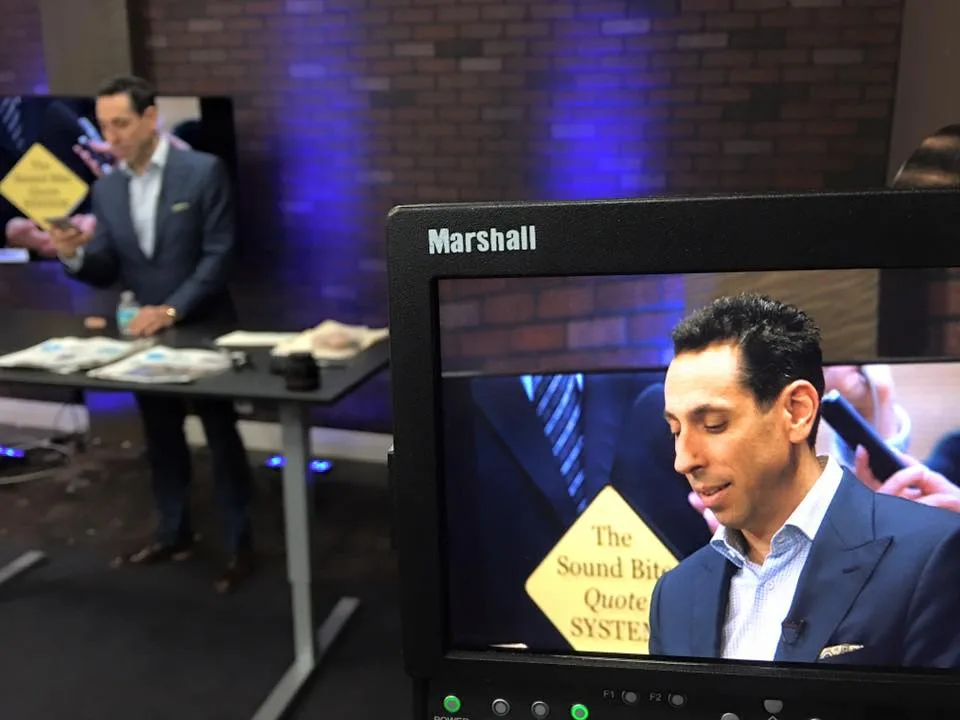
The Sound Bite Quote System is 14 techniques for making an answer quotable: absolutes, facts, examples, action words, shocking statements, predictions, emotion, conflict quotes, cliches, the triple play, rhetorical questions, analogy, humor, and pop culture references. Attach one to a point you already intend to make, rather than reaching for a technique cold.
A good answer that never gets quoted did not work. That is the whole reason this system exists. You can say something true, useful, and on message, and still watch it disappear from the piece because nothing about the sentence gave an editor a reason to pick it over the twelve other answers they recorded that day.
These 14 techniques are how you fix that. None of them change what you are saying. They change the shape of the sentence carrying it, so the point you already wanted to make is the one that survives the edit.
The 14 techniques, with examples
1. Absolutes
Speak in absolutes instead of hedging. "We think this might possibly help" gives an editor nothing to hold onto. "We are 100 percent certain that this works" gives them a sentence with an edge, and an edge is what makes someone stop scrolling.
2. Facts
A fact is a number or a claim someone can verify. Trade a vague claim for a specific one. "Most of our team agrees" is forgettable. "Half of our workforce agrees that..." is a figure a reporter can check, and a checkable figure is one an editor trusts enough to print. If a reporter could confirm it with one phone call, it is a fact.
3. Examples
An example is a concrete instance, a person or a moment the listener can picture. A fact proves the point and an example shows it. "We take customer service seriously" is a claim. "A customer called on a Sunday with a broken order, and our CEO drove the replacement to her door himself" is an example, and it is the one that gets repeated. Reach for an example when the point is abstract, and for a fact when the point needs credibility.
4. Action words
Verbs carry more weight than adjectives. Move, crush, watching, lost: words like these add impact to a sentence that a flatter verb would not. Swap one in wherever the sentence allows it.
5. Shocking
Give an answer that genuinely surprises the person asking the question. "Thousands have died in hospitals without this machine" stops an interviewer in a way a measured, cautious version of the same fact never will.
6. Predictions
The media loves quoting a prediction, especially one with a number attached. "Thousands, even millions, will lose their jobs if this continues" is bold, specific, and exactly the kind of sentence a headline gets written from.
7. Emotion
Facts inform, emotion is what makes an answer resonate. "My heart goes out to this community for what they endured" says something a spreadsheet of statistics cannot. Use it when the moment is genuine, not as a reflex.
8. Conflict quotes
There is drama in conflict, and drama gets covered. "We will take down the competition" is a sentence with tension in it, which is precisely why a reporter reaches for it over a diplomatic non-answer.
9. Cliches
Journalists cannot resist quoting somebody else's cliche, as long as it is attached to a real point. "The bottom line is..." or "At the end of the day..." signals that a complete thought is arriving, which gives an editor a clean place to start the quote. Read the full breakdown in cliches as sound bites.
10. Triple play
Give three items in one answer. "We need endurance, strength, and persistence" has a rhythm a single-item answer does not, and that rhythm is part of what makes it memorable enough to quote.
11. Rhetorical questions
Ask your own question, then answer it. "Are we the one company that can fix this? You bet we are." does the interviewer's job for them and hands over a complete, quotable exchange in a single breath.
12. Analogy
Say this is just like that. "This fix is just a Band-Aid solution" explains a complicated idea in four words, because the listener already understands the comparison you are borrowing.
13. Humor
Humor is quotable, but only when the moment actually calls for it. "The only way to make your PC go faster is to throw it out a window" works because it is unexpected and true. The same line in the middle of a serious crisis answer would not.
14. Pop culture references
A familiar name does the describing for you. "She has been our Mother Teresa" says more in four words than a full paragraph of praise would, because the reference carries its own meaning into the sentence.
Anything quotable is quotable both ways. An absolute or a prediction you cannot actually stand behind is exactly as memorable as one you can, so use these techniques on points you have already thought through, not ones you are improvising under pressure.
You do not need all 14 in one interview
Using every technique in a single answer sounds like a performance instead of a conversation. Most spokespeople settle into three or four that fit how they naturally talk, and save the more dramatic ones, like conflict quotes or shocking statements, for the moments that genuinely call for them.
Where these fit in the bigger picture: first you need somewhere to go, which is the message grid and the three part answer. The sound bite techniques on this page are what make the point land once you have arrived at it. Once you know the list, the sound bite writing exercise and finding a sound bite in today's headlines are both ways to practice spotting and building them.