What is executive communication coaching in a second language?

It is coaching for leaders who already speak English well enough to do the job, but who lose authority when they speak it. The work is not grammar, vocabulary or accent reduction. It is structure, pace, emphasis and presence, so that a leader's experience and judgment reach the room intact. Knowing a subject deeply does not automatically mean being able to communicate it with authority in another language. Those are two different skills, and only one of them is usually trained.

Who this is for

This is the leader who is fluent on paper and flattened in the room. Usually one of these six situations.

  • A senior leader whose first language is Spanish, presenting to a global leadership team in English
  • An executive who is compelling in their own language and noticeably smaller in English
  • A newly promoted leader whose remit just became regional or global
  • Someone who handles prepared remarks well and then loses ground in the Q&A
  • A subject matter expert who is the most knowledgeable person in the room and does not sound like it
  • A leadership team at a multinational where English is the working language but almost nobody's first

What actually changes when you present in your second language

This is the part most training misses, because most training treats the language as the problem. These are the things that actually decide whether a leader sounds authoritative or sounds like they are working too hard.

The accent is almost never the problem

Audiences accept accents easily. What they struggle with is hesitation, a sentence that loses its thread, or an answer that takes too long to arrive. We do not touch the accent. We work on everything that actually costs a leader credibility, which is usually pace and structure.

Translating in your head costs you a beat

Composing in one language and delivering in another adds a delay before every sentence. The room reads that pause as uncertainty about the content, not about the word. The fix is not faster translation. It is building the answer directly in English, from a structure you already own.

Filler multiplies in a second language

Everyone uses filler. In a second language it roughly doubles, because the filler buys time to retrieve a word. The result is a leader who sounds tentative while saying something they are completely sure of. Controlled silence replaces it, and silence reads as authority.

Your natural emphasis flattens out

In your first language you stress the word that matters without thinking. In a second language that instinct goes to the back of the queue behind grammar and vocabulary, so every word arrives at the same weight. A flat line makes a strong point sound routine. Emphasis is trainable separately from fluency.

False friends and register misfire in public

Words that look the same across two languages and mean something different are a standing risk, and business vocabulary is where they cluster. Register is the same trap at sentence level: a phrasing that feels neutral to you can land as blunt or as oddly formal to a native ear.

The Q&A is harder than the talk

Prepared remarks are rehearsed, so they go well and everyone relaxes. Then the unscripted question arrives and the leader has to think, structure and translate at once, in front of the people they most wanted to impress. This is the part worth rehearsing, and it is the part almost nobody rehearses.

Language training versus executive communication coaching

Language or accent trainingExecutive communication coaching
The goalSpeak more correct EnglishCommunicate with authority in English
What gets worked onGrammar, pronunciation, vocabularyStructure, pace, emphasis, presence, message
The accentTreated as a defect to reduceLeft alone. It was never the problem
How you practiceLanguage exercisesRecorded practice of the real situation, with playback
Who teaches itA language instructorA coach who ran a newsroom and has coached executives for 15 years
How you know it workedFluency improvesThe room believes you

How the program runs

Format follows the situation. Most engagements are one of these three.

  • Single-session preparation for a specific event already on the calendar: a board presentation, an all-hands, a conference talk or an interview
  • A half or full day for one leader or a small group, which works well for a leadership team that shares the same second-language challenge
  • Ongoing one-on-one coaching, typically two sessions per month, for a leader stepping into a sustained global role
  • Every format includes recorded practice with playback, individualized feedback, and exercises to use between sessions
  • Sessions can run in English, in Spanish, or deliberately switch inside one session to rehearse a bilingual event

Your coach

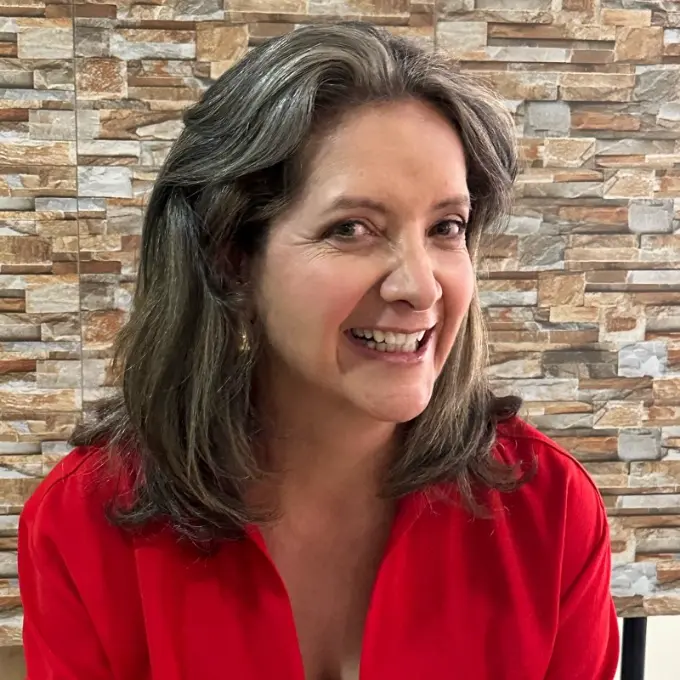
Pilar Ortiz, bilingual executive coach and former Univision news director Univision Tampa Bay, CNN en Español, Telemundo

Pilar Ortiz

Bilingual executive coach · High-impact communication · Media training and executive presence

Pilar Ortiz combines more than 25 years in television and media with more than 15 years of executive coaching, media training and public speaking for executives, business leaders and high-performing teams.

Her work in front of and behind the camera includes Univision, Telemundo, CNN, ABC and NBC. She began her career in Colombia before building most of it in the United States. At Univision Tampa Bay she was anchor and news director for more than a decade, which gave her a rare view of what happens when a leader has to think fast, speak clearly and hold presence under pressure.

She coaches across both languages, which is why this work exists. She knows what it is to move between languages in front of a camera, a journalist or a room, and she does not treat the second language as a deficiency to be corrected.

She is the creator of the Influence Accelerator and Speak Easy programs, and the author of Reinventing Yourself in English and El Genio de la Botella in Spanish. She was the first Hispanic co-host of Voices of Experience, the National Speakers Association podcast.

  • 25+ years in television and media
  • 15+ years of executive coaching
  • Anchor and news director, Univision Tampa Bay
  • Coaches in both English and Spanish
  • Fortune 500 leaders across 50+ countries
The method behind it

The program runs on the same method Jess Todtfeld has used to train more than 100,000 people on six continents. He is a former NBC, ABC and Fox television producer of 13 years, a Certified Speaking Professional, author of the international bestseller Media Secrets, and a Guinness World Record holder for most media interviews given in 24 hours. Pilar brings that method into the executive and bilingual context. The result is real practice, recorded, reviewed and coached, in whichever language the leader actually has to perform in.

Results from Latin America

“Being in front of the camera and watching the evolution from the initial take to the last take, especially under heavy questioning, was very helpful to me.”
Max A. StempelGerente General, AIG Panamá
“This has helped us greatly in improving our speaking skills. In this business, improving these type of skills really matters for your career.”
Ed MenaGerente General, AIU Chile
“Jess' Media Training workshop helped me reduce nervousness and deliver messages that people can remember.”
Pedro ArtanaGerente General, AIG El Salvador

Frequently asked questions

Is this accent reduction?

No, and we would talk you out of it. An accent is rarely what costs a leader authority. Speed, filler, long sentences and flat emphasis are. We leave the accent alone and work on the things the room actually reacts to.

How good does their English need to be already?

Good enough to do their job in it. This is not language instruction. If a leader is still building working fluency, a language program serves them better first, and we are happy to say so.

Is this different from regular presentation training?

Yes, in what gets attention. A second language changes where the effort goes: composing while speaking, retrieving words under pressure, and losing natural emphasis. Standard presentation training assumes those are free.

Can you coach a whole leadership team?

Yes. Small groups of two to eight work well, so everyone gets recorded practice and individual feedback. Teams at multinationals often share the same second-language challenge, which makes the group format efficient.

Do you work in Spanish too?

Yes. Pilar is a native Spanish speaker and coaches fully in either language, or switches deliberately inside a session to rehearse a bilingual event. Some clients start in Spanish and move to English as confidence builds.

What about leaders whose first language is not Spanish?

The work transfers. The mechanics of composing in one language and delivering in another are similar across first languages. The regional and cultural coaching is strongest for Spanish speakers, because that is where the deepest experience sits.

Is it virtual or in person?

Both. Virtual works well, since most of these presentations happen on video anyway and the practice matches the medium. On-site is available for full-day programs and team sessions.

How quickly can you prepare someone for a specific presentation?

A single focused session is often enough for one event that is already scheduled, and we book those on short notice where possible. A sustained global role is better served by ongoing coaching.

What does it cost?

It depends on format, length and how many people are being coached. Ongoing one-on-one executive coaching runs as a monthly program. Tell us the situation and we will send a specific number rather than a range.

Stop letting the language set the ceiling

Tell us who is presenting, to whom, and in which language. We will tell you what the preparation should look like.

Speak with Jess