Updated
Quick answer: To find your voice as a podcast host, aim for the best version of you. Ask people who know you what that looks like, record a practice interview with a friend or family member, and review it for energy, volume and pace. Then breathe, hydrate beforehand, enunciate, and vary your speed.
Authenticity rules nowadays. If you start a podcast by putting on a "radio voice," you will sound like a news anchor from 1985, and listeners will tune out. The persona you want as a host is simply the best version of you. That is the whole idea. Here is how to find it, and then how to get your actual voice ready to carry it.
What does "your authentic voice" mean for a podcast host?
It means being yourself on purpose. You have a way you speak when you are being professional. You have a different way you speak when you are relaxed and not on camera. Your authentic voice is a blend of the two. You are looking for the version of you that is credible and also warm, not the stiff version or the sloppy one.
How do you find the best version of you?
Here is an exercise I like. Ask the people in your life who know you and love you what the best version of you is. It makes for a nice conversation, and you will feel great doing it. Here is a bonus. Tell them what you think the best version of them is. Maybe they are inquisitive and funny, or super smart and always find an angle on something that most people do not see.
I have lawyer friends who may not be the funniest people, but they always find an interesting angle that not everybody sees. That is their superpower. Other people find something clever, or fun, or funny in any topic. You do not have to be all of those things. You just need to be the best version of you, and that usually also means bringing up your energy a little.
Why does your energy need to be higher on video and audio?
Video is a cooling medium. I have been a media trainer for 20 years, and I say this to people all the time. It means that whatever you feel in the room gets muted by the time it reaches the viewer, so you need to bring back a bit of energy. The nice thing about podcasting is that the microphone sits right up against your mouth, so you do not need to shout to be heard. You need warmth and engagement, not volume.
How do you practice before you launch?
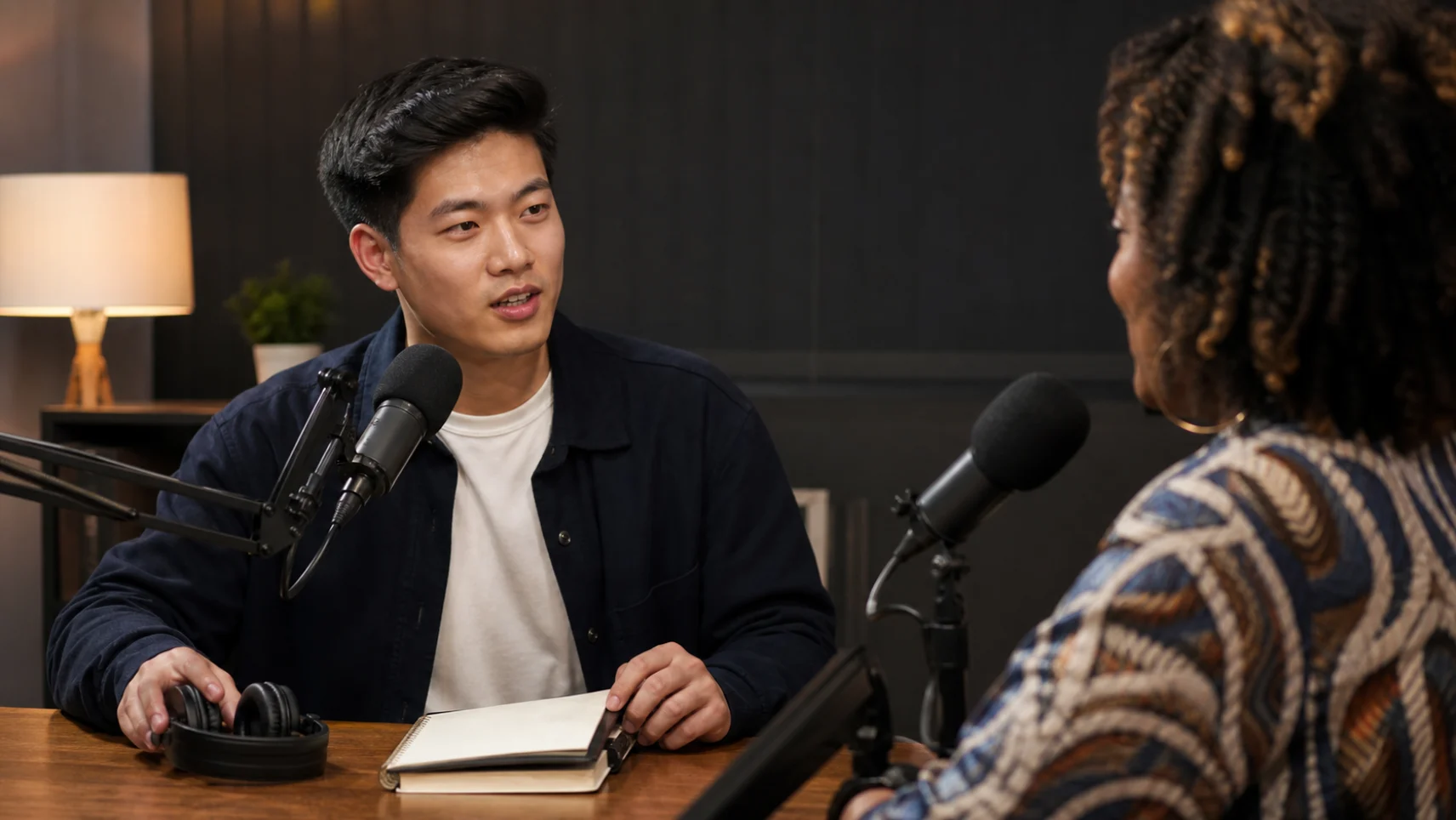
Do a test show. Record yourself interviewing a family member or a friend. Then you have footage to review, and you can see what you like. Are you too loud? Too excited? Maybe you are speaking a little too low, or sitting back from the microphone without realizing you should be closer. You will pick up these nuances when you practice.
When I did this myself with a family member, I told them, "We will have it for posterity." We actually fell into a rabbit hole of "Wait, I need to look right," and "Holy cow, I am not ready," and "I have a blemish." Then I said, all right, it is just a test, so let us just record it. I now have that footage, which I can use going forward. If a family member is not excited about it, pick a friend you can interview and chat with in the same way.
Then watch and listen back. See what worked and do more of it. Notice what you would change and make that adjustment.
What are the biggest mistakes new hosts make?
- Acting too formal. Stiffness reads as distance.
- Reading an entire bio. It sounds like a script, and listeners switch off.
- Playing the "professional version." You end up sounding like nobody in particular.
- Being too excited about something you already know. If you say, "Wow, I have never heard of this type of insurance," the audience thinks, "You probably heard about it when you booked the interview." They can tell it is staged.
Authentic, with good energy, is the target. You are going for the best version of you, and I know I am repeating that, but it will stick.
Should you smile on your podcast?
One last thought: seem like you are happy to be there. That means smiling at appropriate times, depending on the topic. After all, why are you doing this if you are not enjoying it? There will be different levels, such as being extra focused on what a guest is saying, but at the beginning and the end, in particular, look like you are glad to be in the chair. You will find the right medium for your energy over time.
What vocal techniques should podcast hosts use?
I have never done formal vocal exercises, and you do not have to either. If you want to play with them, you can find many on YouTube or the internet. For this article, I am going to bottom-line the most important things.
- Breathe. Breathe beforehand. If you do not have enough breath, you run out of energy. Put all of your focus on making the conversation fun, great and interesting for the audience.
- Hydrate before, not during. Drink your water before the interview, rather than during it. I know late-night talk shows always have water out for the guest in case of dry mouth, but for your recording, drink beforehand and you will be fine.
- Enunciate. In practice, notice whether you are mumbling any words. If there is no issue, great. You do not have to worry about it at all.
- Play with highs, lows and speed. All of us vary the pitch and speed of our voice without realizing it. We speed up when we are excited and slow down when something interesting comes up. Pay attention to that. If you talk really fast the whole time, notice it in practice so you can slow down and let things take the right pace.
- Use your five-minute pre-interview as a warm-up. You are chatting with the guest, and you are also warming your voice and getting your energy together. Two things at once.
Want to go deeper? Look for specific exercises online. For more on voice from a media-training view, read how to improve your speaking voice, how to warm up your voice before an interview and tone of voice and gravitas. If filler words are creeping in, how to stop saying um in interviews will help. Once you know your voice, the podcast host gear checklist will help you choose a microphone that does it justice.
Want an outside ear on your voice and your on-camera energy? Learn about on-camera training or get a quick quote.