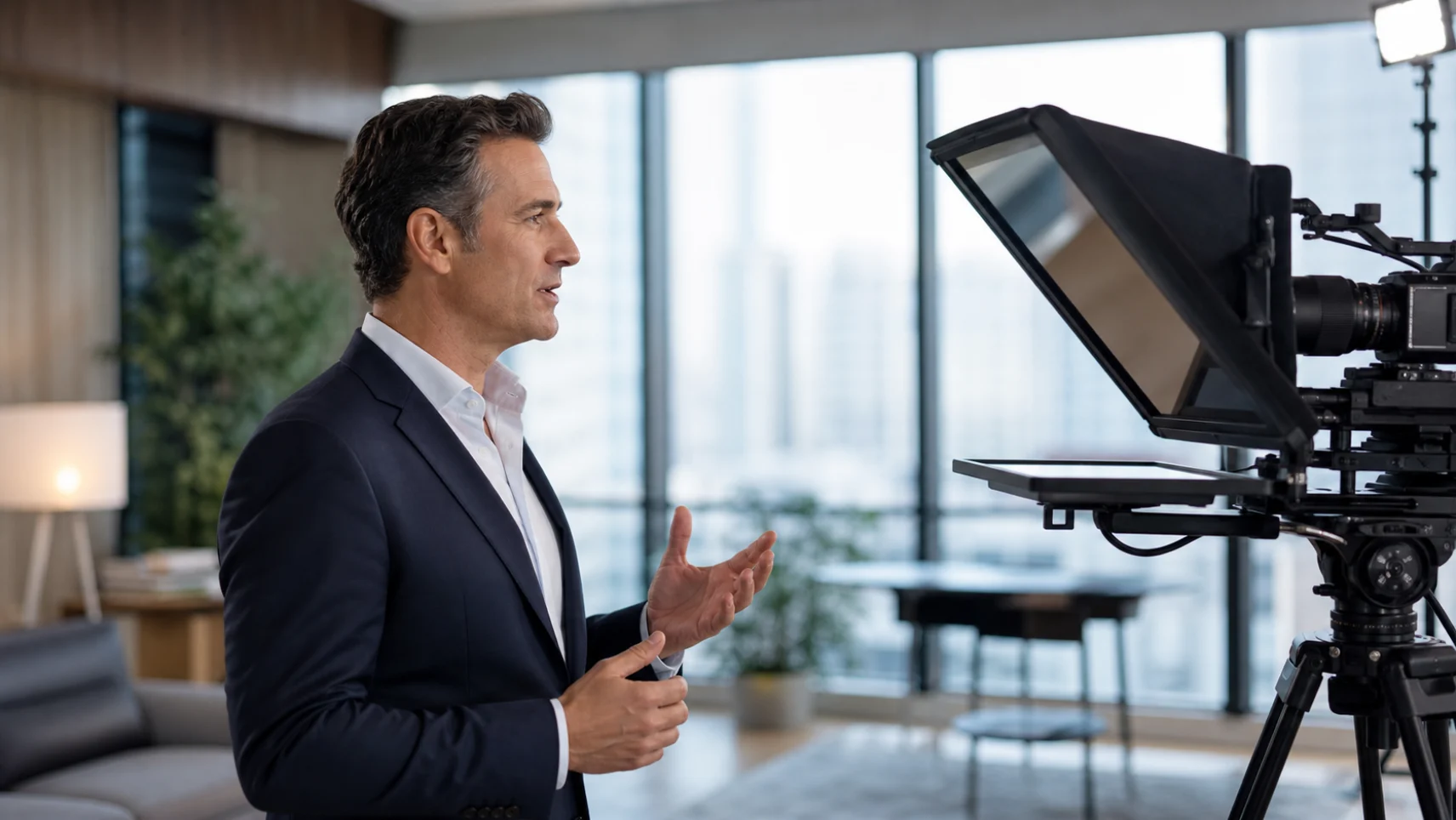
Where you look during a media interview comes down to one rule: look at the person asking the question when they are in the room with you, and look straight into the camera lens when they are not. Every other option is a trap. I have watched executives with excellent answers get scored as evasive by a producer because their eyes went to the monitor, to the floor, to the publicist standing behind the camera. The words were fine. The eyeline was the problem.
Why this matters (and what most executives get wrong)
An audience reads your eyes before it processes your sentence. That judgment happens fast and it happens below the level of argument, which is why it is so hard to talk your way back out of it. Darting eyes get filed under nervous. A gaze parked slightly off to the side gets filed under something to hide. Neither is fair, and neither one cares whether your answer was accurate.
The mistake is almost never a lack of preparation. It is that nobody told the executive the rule, so they improvise in the moment, and the moment is exactly when improvising is expensive.
Person in the room, look at the person. Nobody in the room, look at the lens. If you genuinely cannot tell which situation you are in, ask before you start.
What makes this confusing is that television has trained everyone to think the camera is the audience. In a sit down interview it is not. The reporter is your audience, and the camera is simply overhearing a conversation between two people. Look at the lens during that conversation and you break it, the same way you would break a dinner conversation by turning to address the wall.
The 6-step rule for where to look during a media interview
1. Default to the person asking the question
If a reporter is sitting or standing across from you, look at them. That is the default, and it holds for the large majority of interviews you will ever do: local news, a print or podcast interview being filmed, a documentary sit down, a press gaggle. Talk to the human being. Let the camera do its job.
2. Go to the lens only when they tell you to
There is one clean exception, and it is not a judgment call: the reporter or producer asks you to look into the camera. Some formats want it, usually when your answer will be cut in as a direct address to viewers. When you get that instruction, take it, and then stay there. Do not drift back to the reporter halfway through the answer.
3. On a satellite interview, the lens is the person
In a satellite interview you are in one studio and the anchor is in another. There is no one to look at, so the lens is your interviewer. Look directly into it and hold it. What you will usually see on air is the double box, you in one frame and the anchor in the other, side by side, which means the audience is watching your eyes at the same moment they watch theirs. An eyeline that wanders in that split screen is very visible.
4. On a video call, look at the camera, not the faces
Remote interviews are where good habits go to die, because the natural thing to do is look at the person on your screen. The problem is that the little faces are below the lens, so on the other end you appear to be looking at your own lap. Talk to the lens. If it helps, drag the window with the interviewer in it directly under the camera so the gap between where you want to look and where you should look gets small.
5. Turn off your own picture
Watching yourself is the fastest way to look shifty. Your eyes flick to the monitor to check your hair, your posture, whether that last answer landed, and the camera catches every flick. In a studio, ask them to angle the confidence monitor away from you. On a video call, hide self view. You cannot fix your appearance mid answer anyway, so remove the temptation entirely.
6. Hold the eyeline through the pause
The most common tell is not during the answer, it is in the half second before it. A hard question lands, the executive looks up and away to think, then comes back. On camera that reads as searching for a story. Learn to think while still looking at the reporter, or at the lens. A short silence with a steady eyeline reads as considered. The same silence with a wandering eyeline reads as caught.
Nobody has ever been called evasive for pausing. They get called evasive for where their eyes went during the pause.
The mistake most executives make
The pattern I see most often is the executive who checks in with someone in the room. A communications lead is standing behind the camera, and after each tough answer the spokesperson glances over to see how it went. It is a completely human thing to do, and on camera it looks like asking permission.
The second pattern is treating the eyeline as a style choice instead of a format question. Executives will tell me they prefer looking at the camera because it feels more direct, and then they do it in a two person sit down where it reads as strange and stagey. This is not a preference. The format tells you where to look, and the format changes from booking to booking.
The fix for both is the same and it takes ten seconds: before you go on, ask the producer or reporter where they want your eyes. They answer this question all day. Nobody has ever thought less of a guest for asking it, and it removes the one variable that you cannot correct once the recording starts.
Case study: the spokesperson who kept checking the room
An anonymized in kind scenario, generalized from a pattern that comes up in nearly every on camera session. A nonprofit executive was about to do a run of interviews about a program launch, including two remote hits and one in studio. In rehearsal her answers were strong and specific. On playback, she was surprised by her own recording: on every question with any edge to it, her eyes went up and to the left, and on two answers they went past the camera to where her communications director was sitting.
We did not touch a single word of her content. We turned off her self view, moved the laptop window with the interviewer under the webcam, and asked the communications director to sit behind her instead of behind the camera. Then we ran the hard questions again and told her one thing: think with your eyes where they already are.
The second playback did not sound different. It looked completely different. The same answer, delivered with a steady eyeline, came across as a person who knew the material rather than a person hoping she had said the right thing. That is the whole return on this, and it costs nothing to set up.
Where to look, by interview format
| Format | Where to look | What kills it |
|---|---|---|
| In person sit down with a reporter | At the reporter, the whole time | Addressing the lens, which reads as stagey |
| Reporter asks you to look at camera | Into the lens, and stay there | Drifting back to the reporter mid answer |
| Satellite interview, double box | Straight into the lens | Watching the return monitor of yourself |
| Video call interview | Into the webcam, not the faces | Looking at the screen, which reads as looking down |
| Panel or press gaggle | At whoever asked the question | Scanning the room for approval |
| You honestly cannot tell | Ask the producer before you start | Guessing on air and switching halfway |
None of this is a talent. It is a set of defaults you decide before the recording light comes on, so that in the moment you are thinking about your message instead of your eyes.
What to do next
Do one thing before your next booking: ask what the format is, and then set your eyeline to match it. If your spokespeople are heading into a run of interviews and you want this trained in with real cameras and real playback rather than a briefing document, get a quick quote and we will build the session around the interviews they are actually about to do.
Next, read body language in a media interview, since the eyes are one of three things moving at once, and how to prepare for a media interview so the answers are ready before the eyeline ever matters.