
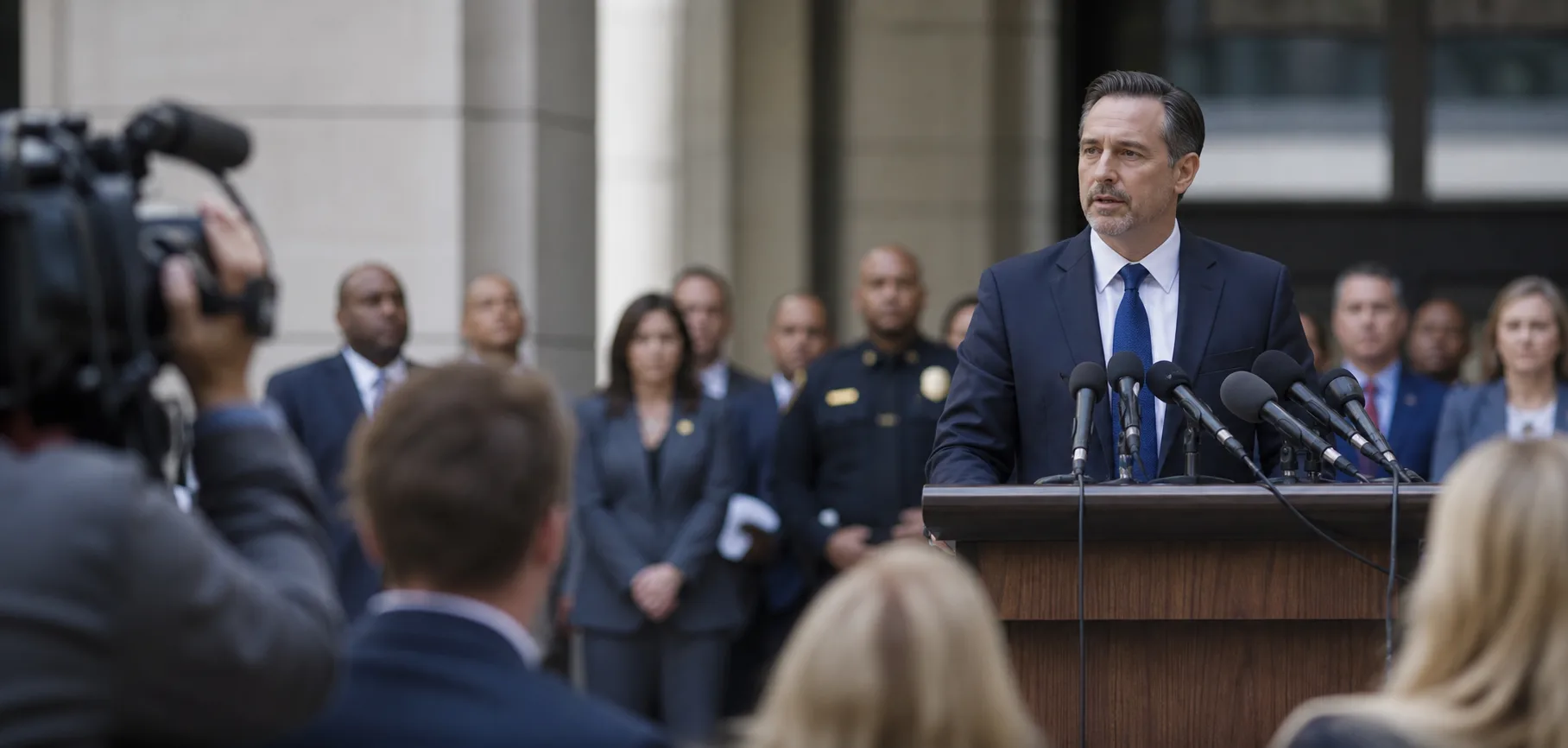
Decide first whether to address it at all. If your goal is to be out of the story, do not reintroduce it, because the interviewer may never raise it. If you do address it, own it in one sentence and move on, do not relitigate it. And consider the third option most teams skip: call the moment and use it.
A spokesperson says something, or wears something, or makes a face, and by evening it is a clip. Not the story you were working on. A different story, about them.
The instinct in the room is always identical: we have to fix this. Sometimes that is right. Very often it is the fastest available route from one bad day to a bad week.
In a two-day session with a federal agency in Washington DC in August 2026 we worked this exact scenario, and what came out of it was less a set of talking points than a decision tree. Three steps, in order, and the order matters considerably more than any individual line.
Step one: does this need to be addressed at all?
Everything turns on one question, and it is not "was it bad." It is: what is the goal?
If the goal is attention, you already have it, and the clip is an asset you can spend. If the goal is to be out of the story, then the most powerful instrument available to you is not a correction. It is silence.
Here is the part that surprises people. Raising it yourself may be the only reason it comes up. A reporter with twenty minutes and a subject they genuinely want to cover will often never mention the clip at all. If you open with "I want to address what people saw yesterday," you have just donated the first three minutes of that interview, and probably the headline, to the very thing you wanted to leave behind.
I produced television for thirteen years at ABC, NBC and Fox, so I can tell you exactly what a producer does with an unprompted apology. It goes at the top. It is more interesting than whatever the segment was booked for. You did not defuse anything. You handed over a better lede.
- If the goal is attention: the clip is fuel. Skip to step three.
- If the goal is quiet: do not reintroduce it. Prepare a short answer in case you are asked, and do not deploy it unless you are.
- If you cannot tell: assume quiet. Reintroducing the story is a one-way door. Staying quiet for another day is not.
There is one obvious exception, and it is not a small one. If the clip contains something factually wrong, or something that hurt people, silence is not neutrality, it is a position. Correct it. But correcting an error is a different action from managing an embarrassment, and treating the second like the first is how organizations manufacture crises out of awkward moments.
Step two: how do you own it without relitigating it?
The failure mode here is not apologizing. It is explaining.
A person who owns a moment in one sentence gets one news cycle. A person who explains what they really meant, and what was taken out of context, and what the fuller point actually was, gets a second story about the explanation. The second story is always worse, because now the subject is your judgment rather than your remark.
Two constructions are worth carrying, and both correct without reopening.
- "I want to add on, or make a slight adjustment to what I said." Neutral, forward-facing, and it does not concede a scandal that may not exist. It treats the moment as housekeeping, which is often what it deserves.
- "You may have heard this. What I was really going for is..." Acknowledges reality in six words, then spends all of its remaining energy on the message rather than the mistake.
Both are short on purpose. Then you keep talking about the actual subject. The length of your correction tells the audience how big the problem is. Speak about it for eight seconds and it was an eight-second problem.
Did they misspeak, or did they mean it?
This is where the room in Washington genuinely split, and I do not think there is one clean answer.
If a person misspoke, said something they did not mean, or got a number wrong, own it and move. That is straightforward, and the walk-back is credible for the simple reason that it is true.
If they said exactly what they meant, and the problem is that people did not care for it, a next-day walk-back reads as revisionism. It creates a second story, and that story is about whether you are being straight with people, which is a far more durable subject than the original clip.
The honest counter, argued hard in that room, is that leaders do change their minds and saying so out loud is not weakness. That is true. But it is a different act and it has to be labelled as one. "I have thought about this and I have changed my view" survives contact with a reporter. "What I actually said was" does not.
We did not fully resolve it. What we did agree on was the test: are you correcting the record, or correcting the reception? Only one of those is honest, and audiences are considerably better at telling them apart than communications teams tend to assume. There is more on the mechanics of handling the direct version of this question in how to answer tough media interview questions.
Step three: can you have fun with it?
This is the option almost nobody weighs, and it is frequently the strongest one on the table.
Comedians have a name for it. They call the moment. A stand-up is midway through a set when a tray of dishes hits the floor. Instead of pretending nothing happened, he waits for the crash to finish, looks up, and says: "was it something I said?" The room, which was about to be lost, belongs to him again inside two seconds.
The mechanism is worth understanding, because it is not really about being funny. An audience that has noticed something you are visibly pretending not to notice has stopped listening to you. They are now watching to see whether you will acknowledge it. Naming the thing releases them. What you say when you name it barely matters. That you named it is the whole trick.
The public example everyone knows is Bernie Sanders and the mittens. A photograph from an inauguration became a meme within hours, and the response was not a statement about decorum. It was merchandise, with the proceeds going to charity. Within two days the story had stopped being about him and had become something he was in on.
I worked with a senior official who went viral during a high-profile posting for exactly one reason: his hair. Not his policy, not a gaffe, his hair. His team's first instinct was to ignore it entirely and hope it burned itself out. They did the opposite the following day and leaned into it, lightly, with a nod rather than a campaign. The story was finished in about a day. Ignoring it would have turned every subsequent appearance into a hair-watch, with reporters waiting to see whether he had responded to it.
- It works when nobody was harmed, the clip is about style rather than substance, and a light response would not be an insult to anybody involved.
- It fails when there is a victim, a safety issue, legal exposure, or genuine anger. Humor over a real grievance reads as contempt, and contempt becomes the next clip.
- It requires a person who can do it. A leader who cannot deliver light material should not be handed light material an hour before a camera.
The judgment call is not whether the line is funny. It is whether anybody is owed something serious first.
What should you do in the first twenty-four hours?
Before you choose any of the three paths, work through this in order.
- Watch the clip the way an outsider will. Muted, on a phone, without the context of the full remarks. That is the version that is travelling, and it is often meaningfully different from the one you remember being in the room for.
- Establish whether it is actually travelling. A clip your own staff are passing around is not the same thing as a clip with reach. Check whether reporters are asking, not whether colleagues are talking.
- Prepare the short answer regardless. The worst outcome is being asked and having nothing ready, because that produces the long defensive version, and the long defensive version is story two.
- Decide the goal and write it down. Attention or quiet. Everything else follows from that single choice, and it is the step most teams skip entirely while arguing about wording.
If your organization handles these situations regularly, the reflex is worth building before you need it. That is what crisis communication training is actually for, and it is why understanding what journalists are thinking changes the calculation.
How do you know when it is over?
When the questions stop, it is over. The single biggest mistake at that point is a public retrospective. An internal review is fine and often useful. A public one restarts the clock and hands the story a second life it had already given up on.
The other tell is the interviewer's opening question. If the first thing you are asked about is your actual subject, the clip is behind you. Take the gift and do not go back for it.
The mistake underneath all the other mistakes
Nearly every serious error in this situation is an error of proportion. Organizations answer a ten-second clip with a ten-day process, and the process becomes the story. Three steps exist to keep the response the same size as the problem, and most of the time the correctly sized response is smaller than the room wants it to be.
If your spokespeople face cameras and your organization would rather build the reflex in a room than discover it live, tell us about it here.