
Updated September 2026
Promoting in a media interview works when you give first and ask once. New survey data from nonfiction and memoir authors found that podcast and media appearances produced stronger engagement than paid advertising, and that speaking and live events were the single strongest indicator of direct sales. The plug that lands is one clear next step, delivered after you have already been useful.
Most people treat the plug as the price the audience pays for the interview. They hold it back, get anxious about it, then jam it into the last thirty seconds in a rush. It sounds like exactly what it is, and it converts like it too.
There is now data suggesting that instinct is backwards, and that interviews are doing more commercial work than the channels people spend actual money on.
Why do interviews beat paid ads right now?
Jenn T. Grace, founder of the hybrid publisher Publish Your Purpose, was a guest on my Game Changers podcast to talk about a survey she runs on how authors market their books. She built it because the number everyone repeats about book sales turned out to trace back to a single industry estimate from 2006.
Her first year of results found three things that apply well beyond authors.
The paid ads finding came with an important asterisk from Grace herself: participants who ran ads did not get the return they expected, but the survey did not yet ask whether they had a goal and a plan before they started spending. That question is in this year's edition.
What the engagement finding does tell you is that an interview buys something an ad cannot. Someone chose to listen to you for twenty minutes. By the time you say where to find you, they already know whether they like you.
Here is the full conversation, including the stat she spent eleven years repeating before she checked it.
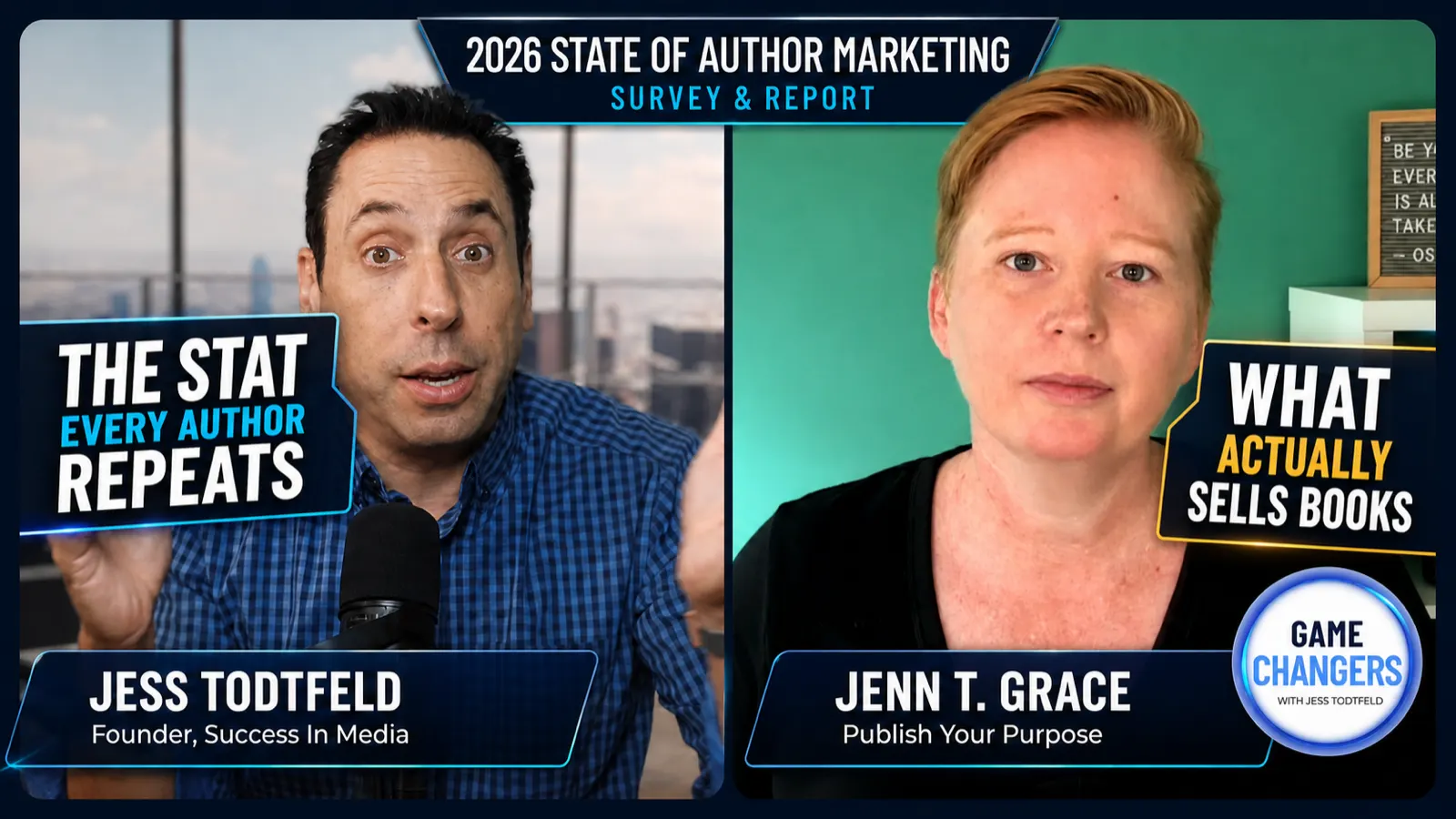
Jenn T. Grace on Game Changers: the stat every author repeats, and what actually sells books.
What does plugging actually mean?
The word plug is part of the problem. It sounds like forcing something in where it does not belong, and people feel bad about themselves doing it.
I read it as an acronym instead. PLUG: Properly Leverage Ur Gift.
Your gift is the thing you actually know. In the interview you give some of it away. You pick one idea and go genuinely deep on it, so the audience walks out holding something they did not have before. Then, when you point them somewhere, you are not interrupting the value. You are telling people who just received something where the rest of it lives.
That is the sweet spot. The audience thinks: what you gave was useful, I want more, how do I get the whole thing. Answering that question is a service, not a sales move.
If you removed your plug entirely, would the interview still have been worth the audience's time? If yes, you have earned the ask. If no, the plug was never the problem.
How do you plug without sounding like a pitch?
Grace framed it through Gary Vaynerchuk's Jab, Jab, Jab, Right Hook: give, give, give, then ask. Readers do not appreciate the used car salesman approach of shoving a product in their face on every post. Nobody wants to hear go buy my book, go buy my book.
Inside a single interview, that sequence compresses into four moves.
- Give the specific thing. Not your background. One usable idea, explained well enough that someone could act on it tomorrow.
- Name one destination. One. Not a website, a book, a newsletter, and a workshop. People remember one.
- Say it in plain language. If the audience cannot repeat it back without writing it down, it is not a plug, it is a URL nobody will find.
- Stop. Do not re-plug. Repeating it does not increase recall, it increases the sense that the whole interview was an advertisement.
The structural failures underneath a bad plug are almost never about the plug. People bury the point, run long, or ask for four things at once. That is what media interview training fixes: the shape of the answer, which is what makes the ask audible when it arrives.
Why does launch week mislead you?
This is the finding I would put on the wall. Grace found that relying on launch week as the number you go on brings you to false conclusions. Growth showed up across the first twelve months, and then beyond the first twelve months, for the people who stayed visible and kept engaging.
And yet the standard pattern is to pour every dollar and every favor into one week, hire specialists to help do it, then fade into the sunset and expect the thing to keep selling.
For interviews specifically, this means the booking calendar should not empty out the day after launch. The authors and founders who kept doing interviews were the ones who kept seeing results. One interview in month eight is worth more than three more in launch week, because launch week already has your attention and month eight is where everyone else quit.
Does social media without a strategy help?
Directly from the data: social media without a strategy or consistency is a drain on time and motivation.
That is worth hearing clearly, because everyone is telling you that you have to be on it. The finding is not that social does not work. It is that unplanned social costs you something real, and it costs you motivation before it costs you anything measurable. If posting daily is draining the energy you would need to pitch three podcasts, the podcasts were the better trade.
The same logic applies to live video. I did a lot of it during my own launches and treated it as a speaking opportunity, which is what the data says works: pick one chapter, go deep, give people something real. That is a strategy. Posting because it is Tuesday is not.
What should you fix before your next interview?
Three things, in this order.
Decide the one destination. Before the interview, not during it. Write it down. If you cannot pick one, you do not have a promotion plan, you have a list of assets.
Pick the idea you are giving away. The generous version. Interviews where the guest protects the good material are the ones that produce nothing, because there is nothing to want more of.
Plan the twelve months, not the week. Interviews compound. The one that produces a client in March is often one you recorded in November and forgot about.
For the full tactical version of this, before, during, and after the interview, see how to leverage media interviews. If you are working specifically on a book, media training for authors and a book publicist's 4-decade playbook cover the adjacent ground.
Survey findings in this article come from the first edition of the State of Author Marketing survey, run by Jenn T. Grace with 233 participating authors. The 2026 survey is open now.