
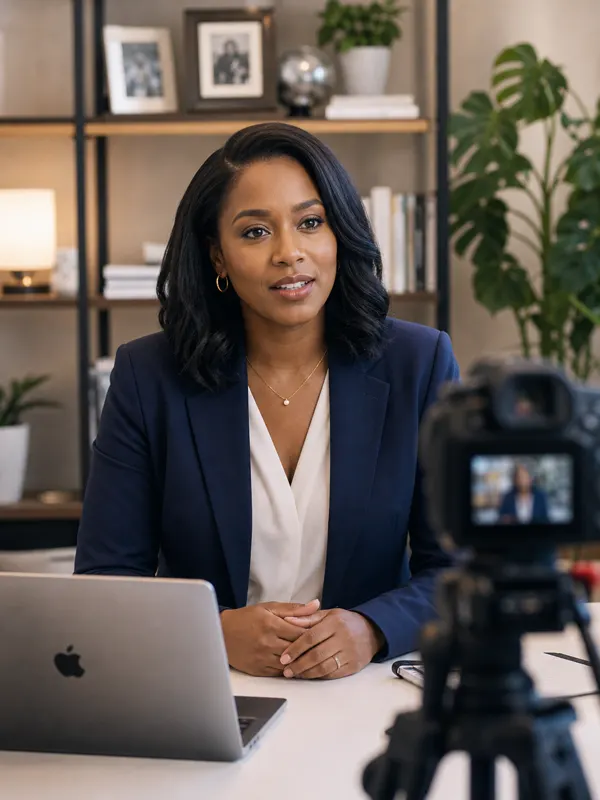
Social media coaching is on-camera training for the people who already work for you, so the experts on your staff can carry your video and podcast content themselves rather than handing it to a hired presenter. Less of it is about lighting and captions than people expect. Most of it is about register: how much energy is the right amount when you are being yourself, on purpose, on a schedule.
I get a version of the same call every few weeks now. A communications lead says a couple of us do digital for a living, and everybody else on the list is a specialist of some kind: a researcher, an analyst, someone who owns a subject. Smart people. Genuinely expert. Nobody hired them to be on camera and nobody warned them it was coming.
Then comes the line that gives the real problem away. "They are doing fine. It just does not sound like the same organization twice."
Why this matters (and what most executives get wrong)
The assumption is that this is a talent problem. Find the one person who is naturally good, put them in everything, and quietly stop asking the others.
It is a standard problem. I have watched the same person get coached into two opposite ditches over a handful of recordings. They come in bright and warm, someone says the subject is serious so bring it down, and they take the note honestly. The next recording is flat enough that you can hear the attention leave. Same person, two takes, both wrong, and nobody in the room can say where the middle actually sits, which means the next note will be just as much of a guess.
There is a second thing nobody plans for. Setting changes people more than any coaching does. The same expert shrinks outdoors because strangers are walking past, then shrinks again indoors because colleagues are listening from their desks. That is not a confidence issue you fix with a pep talk. It is a rehearsal issue.
And underneath all of it sits the oldest problem in my business. Deep expertise is fluent in one room and unintelligible in the next. Specialists tell me, almost apologetically, that people outside their field say they cannot follow them once the peers leave the room. That is not a flaw. It is what specialization does to a vocabulary.
The 5-step social media coaching method for in-house experts
1. Decide what your organization sounds like before you coach anyone
Ten minutes each, in writing, before any camera comes out: what are the two or three things we always say about this subject, and what do we never say? Do it in advance and you skip the half day of a training session that otherwise gets eaten inventing it live. Skip it, and every person on your list quietly builds their own version, which is exactly how one organization ends up sounding like five.
2. Record both extremes on purpose
Ask for a take that is deliberately too much. Then a take that is deliberately too flat. Watch them back to back with the person who made them. The middle stops being anyone's opinion at that point, because it is visible on screen, and the person can find it again on their own next week. This is the single fastest exercise I know for tone, and almost nobody does it, because it feels silly for about ninety seconds.
3. Trade jargon for consequence, not for simpler words
Accessible does not mean dumbed down. It means the listener gets there. There are four layers, and they stack: do they understand it, do they remember it, can they act on it, can they pass it on to somebody else. Miss the first and the other three never happen. The practical move is to lead with what it means for the person watching, then give the detail behind it. Experts almost always do that in the opposite order, and lose the room in the setup. Audience-centered communication goes deeper on the reordering.
4. Coach whoever is holding the camera
This is the step that decides whether any of it survives. The person who films and edits your content is the only one present at every recording, and they are the one who has to say "that one was flat, go again" three months from now. Give them the same vocabulary as everyone else. Without it, feedback collapses into personality: one reviewer is too kind to say the take was bad, another is blunt enough to be right and unhelpful at the same time, and the expert on camera learns nothing from either.
5. Put the reps in the publishing calendar, not in a training day
A day of training creates the memory of what good feels like. Reps are what keep it. If your channel publishes weekly, the practice has to live in that same rhythm, even if it is one extra recorded take before the one you keep. I would rather a team do two honest reps a week forever than eight hours once and nothing after.
The mistake most executives make
They coach tone as if it were personality, and personality is the one thing on the list nobody can take a note on.
"Be more energetic" is not a note. Neither is "be more natural", which is the cruelest one, because the person hearing it is already trying. Both leave the expert guessing, and guessing on camera looks exactly like discomfort. I spent thirteen years producing at ABC, NBC and Fox, and the guests who fell apart were rarely the ones who knew less. They were the ones who had been given vague direction thirty seconds before the light went on.
The fix is boring and it works. Notes have to point at something the person can actually do differently: start with the consequence, cut the first sentence, look at the lens on the last line, slow the middle down. Behavior, not adjectives.
If your feedback would sound like a compliment or an insult when read back out loud, it is not coaching. Real notes are almost always dull: shorter opening, one idea, land the last word, do it again.
Case study: the team that kept getting whiplash on tone
An anonymized in-kind scenario, built from a pattern I see across technical and mission-driven organizations rather than from any one client.
An organization decides its own people should be the faces of its video and podcast content. The reasoning is sound. The expertise is in the building, and hiring an outside presenter to read it aloud fools nobody. So a small group of staff gets added to the on-camera list. A few of them do communications for a living. The rest are subject-matter people whose job descriptions never mentioned a camera.
The first months go the way they always go. One person is warm and quick and slightly too much for a serious topic. Another knows the material better than anyone in the building and delivers it in a voice that flattens by the second sentence. Feedback goes out after each shoot, kindly, and it swings, because there is no agreed standard to swing against.
What changed it was not a lecture. It was two hours of paired takes. Every person recorded a version that was too big, then a version that was too small, and watched both. Almost everyone was surprised in the same direction: the take that felt embarrassingly big was the one that read as normal, and the one that felt calm and professional read as bored. That gap between how you feel and how you look is the whole reason the camera has to be in the room.
Then the standard got written down. Three things we always say, two we never say, and one rule for openings. The person who films everything sat through all of it, so the standard belonged to the team rather than to a trainer who was leaving that afternoon.
The output did not become slicker. It became consistent, which is the thing an audience actually notices, and it stopped costing a week of internal argument per video.
Feedback that moves someone, and feedback that makes them worse
| Works | Backfires |
|---|---|
| "Start with what it means for them, then the number." | "Make it more engaging." |
| "That opening took nine seconds. Get to it in three." | "Bring the energy down a bit." |
| "Do one deliberately bigger take so we can see your range." | "Just be yourself on camera." |
| "Last sentence, look at the lens and stop talking." | "You sounded a little flat." |
Everything in the left column is something a person can do on the next take. Everything on the right is a verdict.
What to do next
Do the cheap version this week. Pick one person on your list, record a deliberately big take and a deliberately flat take of the same sixty seconds, and watch them together. You will learn more about your team's real range in ten minutes than in a month of notes after the fact.
If the wider problem is that your experts are fluent with peers and lost with everyone else, on camera training for subject-matter experts covers the individual side of that, and on-camera training is the structured version for a whole team, built around recorded reps and immediate playback.
If you want a straight answer on what coaching your group would take, get a quick quote and tell me who is on the list and what they are being asked to publish.