[email protected]

Presentation Training for C-Level Executives

At the C-level, every presentation is a leadership moment. Deliver with the confidence, clarity, and authority your position demands.

Why C-Level Executives Need Presentation Training

C-level executives face a paradox: the higher you rise, the more your success depends on presentation skills, yet fewer people are willing to give you honest feedback. Board presentations, earnings calls, investor meetings, and company-wide addresses are moments where leadership is either reinforced or undermined. A CEO who stumbles through an earnings call can erase billions in market value. A CFO who cannot explain financial results clearly loses analyst confidence. A CTO who cannot translate technical vision into business impact gets sidelined in strategy discussions. At this level, good is not good enough -- your presentations must be exceptional.

Research consistently shows that CEO communication quality correlates with company valuation. Analysts, investors, and employees judge leadership partly through presentation performance. A C-level executive who communicates vision clearly attracts better talent, secures more favorable terms from partners, and builds the internal culture that drives execution. The cost of poor executive communication is real and measurable -- in stock price volatility, in employee disengagement, and in strategic initiatives that fail because leaders could not build alignment through compelling presentation.

What You Will Learn

  • Deliver board presentations that demonstrate command, transparency, and strategic vision
  • Handle earnings call Q&A with composure, precision, and message discipline
  • Present investor pitches that build confidence and drive valuation
  • Lead all-hands meetings that align, inspire, and energize the entire organization
  • Navigate hostile or skeptical questions with grace under pressure
  • Project executive presence through voice, posture, and pacing

Real-World Scenarios We Prepare You For

The Board Strategy Presentation

You are presenting your three-year strategic plan to the board of directors. Several board members are skeptical of your proposed direction. You have 30 minutes to present a compelling case, handle pushback, and secure approval. Your credibility and your strategy are both on the line.

The Quarterly Earnings Call

Analysts and investors are listening live. Your prepared remarks must be clear, confident, and precise. The Q&A session will test your ability to handle pointed questions without revealing competitive information or creating market uncertainty.

The Company-Wide All-Hands Meeting

You are addressing 5,000 employees after a difficult quarter. Morale is fragile. Your presentation must be honest about challenges while inspiring confidence in the path forward. Every word will be analyzed and quoted internally for weeks.

What a C-Suite Session Actually Looks Like

Executive presentation training here is not a lecture on slide design. It is a working session built around the specific room you are walking into next: the board meeting, the earnings call, the investor roadshow, the all-hands after a hard quarter. Most C-level engagements run as a one-day intensive, in person at our Madison Avenue studio, at your office, or fully virtual, and every hour is spent on your material rather than on generic examples.

1. Define the decision, not the topic

We start at the end. What do you need this audience to do, approve, fund, or believe when you stop talking? Executives routinely arrive with a topic ("the FY plan") and leave with a decision ("approve the reallocation before the March board call"). Everything after this step is judged against whether it moves the room toward that specific yes.

2. Rebuild the structure on one page

Your content gets compressed into a single-page blueprint: the opening that earns attention in the first 30 seconds, the two or three load-bearing points, the proof for each, the objection you know is coming, and the close. Board members and analysts do not remember decks. They remember the shape of your argument.

3. Build the persuasion layer

Data alone rarely changes an executive audience. We work on the story, the analogy, and the one visual that makes the abstract concrete, then stress-test whether a skeptical board member could repeat your point back correctly after hearing it once.

4. Pressure test on camera

You deliver, we record, you watch the recording immediately, and you run it again. Then we run the hard version: the interruption at minute two, the CFO who challenges your assumption, the director who asks the question you were hoping to avoid. Repetition under pressure is what converts a good plan into something you can execute when the stakes are real.

The intensive is followed by a 365-day continuity program: coach access before your next high-stakes moment, a full retake of the online course, and a library of short refresher lessons you can pull up in the car on the way to the meeting. The point is that six months from now, before an unplanned crisis address, you are not starting from zero.

The C-Suite Habits We Fix First

Senior leaders rarely have a delivery problem in the ordinary sense. They have specific, high-cost habits that nobody in the organization is positioned to name. These are the ones that come up most often in executive sessions.

  • Leading with context instead of conclusion. Boards want the headline first. Building up to the point the way you would in an internal review reads as hedging to a director who has 30 minutes and four agenda items.
  • Answering the question you prepared for. Under pressure, executives reach for the rehearsed answer even when it does not match what was asked. Analysts notice immediately, and it costs more credibility than admitting you will follow up.
  • Overloading the deck as insurance. Slides built to survive being forwarded are the wrong slides for a live room. We separate the presentation deck from the leave-behind and stop them from fighting each other.
  • Flat delivery under stress. Many leaders compensate for nerves by getting quieter, faster, and more monotone at exactly the moment they need to sound most certain. We rebuild pacing, pause, and emphasis so pressure reads as command instead of tension.
  • Treating the Q&A as an afterthought. On earnings calls and in board rooms, the unscripted portion is where reputations are made. We prepare it as deliberately as the prepared remarks.
  • Different stories from different leaders. When the CEO, CFO and COO each frame the same strategy differently, the audience hears uncertainty. Team sessions exist largely to close this gap.

Formats, Group Size, and Scheduling

C-level engagements are scoped to the situation rather than sold as a fixed package. The formats leaders choose most often:

  • One-on-one intensive: a full day with a single executive, private and completely confidential. Best for a CEO preparing for a specific board presentation, a new leader stepping into a public-facing role, or an executive who wants a system built around their own voice.
  • C-suite cohort: a small leadership group trained together, usually four to eight people over one or two days. This is the format that produces consistent messaging across the top team, and per-executive it is the most efficient option.
  • Targeted pre-event prep: a half day or a focused block before a named event, such as an earnings call, an investor day, a shareholder meeting, or an integration announcement. Short, specific, and built entirely around that one appearance.
  • Virtual delivery: fully remote sessions work well for distributed leadership teams and for on-camera practice, since most of the moments you are preparing for now happen through a lens anyway.
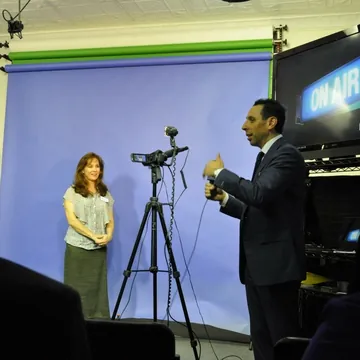
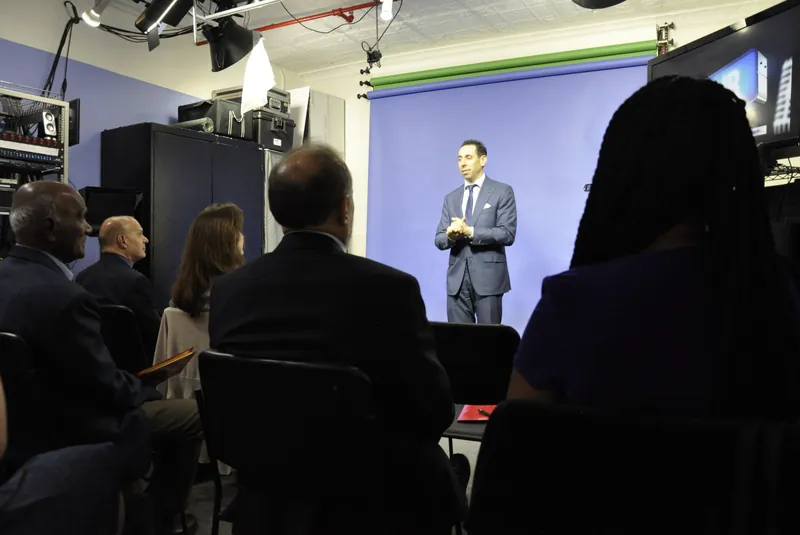
  • NYC studio: in-person training at our Madison Avenue location with broadcast-quality cameras. See presentation training in NYC for studio details.

Standard scheduling for a one-day intensive is typically two to four weeks out. When there is a fixed date already on the calendar, tell us the date on the quote form and we will work backward from it. Urgent pre-event prep has been delivered on far shorter notice when the calendar allows. If you are weighing individual coaching against a team session, we compare the two in one-on-one versus group presentation training.

What It Costs, and How You Will Know It Worked

Pricing is per engagement rather than per hour, and two things move the number: how many executives are in the room, and the level of ongoing support attached afterward. Across our programs, engagements generally sit in the range described in our answer on what training costs, and every engagement includes the 365-day support program at no extra charge. For an exact figure scoped to your situation, request a quick quote or book a call with Jess.

Measurement at this level is not a smile sheet. Before the session we agree on what would count as a win, and it is almost always situational: the board approves the plan, the analyst questions get shorter because the prepared remarks answered them first, the all-hands generates questions about the strategy instead of about whether leadership is being straight with people. We also use the recordings. The first run and the last run of the same content, played back to back, is the most honest measure of change there is, and it is usually the moment an executive stops treating this as a soft skill.

If you want to see how other leaders think about the return before you commit, our knowledge center covers whether presentation training is worth it, how to measure presentation training ROI, and 50 of the most common presentation training questions in detail.

Why Work with Jess Todtfeld

Jess Todtfeld is one of America's leading presentation and media trainers. A former television producer for NBC, ABC, and FOX, he brings an insider's understanding of what makes communication compelling. He holds the Guinness World Record for the most media interviews given in a 24-hour period (112 completed, 96 certified) and has earned the Certified Speaking Professional (CSP) designation, a distinction held by less than 1% of professional speakers worldwide and by just over 12% of National Speakers Association members. Jess has trained executives, leaders, and professionals at Fortune 500 companies and organizations across every industry. His approach is direct, practical, and focused on real-world results.

Jess has trained C-level executives across Fortune 500 companies, understanding the unique pressures and expectations at the highest levels of organizational leadership. He provides the candid, direct feedback that executives rarely receive from their own teams, focusing on the specific behaviors and techniques that project executive presence, build credibility, and drive action.

Frequently Asked Questions

Absolutely. Jess works under strict confidentiality with all C-level clients. Sessions are private, materials are secured, and no client information is ever shared or referenced publicly without explicit permission.

Programs are available as a one- or two-day intensive or in a custom format. Many C-level executives prefer a series of focused sessions around specific upcoming events such as board meetings, earnings calls, or industry keynotes.

Yes. Many executives engage Jess for targeted preparation before a critical board presentation, investor meeting, or public address. He works on content, delivery, and Q&A preparation.

Yes. Team-based executive presentation training ensures your entire leadership team presents with a consistent, polished standard that reflects well on the organization.

A one-day intensive covers message and structure work on your real material, persuasion tools such as story and analogy, on-camera delivery practice with immediate playback, and a simulated hostile Q&A. You leave with a one-page blueprint for the specific presentation you are preparing, not a folder of generic tips.

Pricing is scoped per engagement and depends mainly on how many executives are trained and how much ongoing support is included. Every engagement includes a 365-day continuity program at no additional charge. The fastest route to an exact number is a quick quote or a short call with Jess.

They solve different problems. One-on-one is better when a single leader has a specific high-stakes appearance coming up or wants a system built around their own voice. A team cohort is better when the goal is consistent messaging across the C-suite, and it costs less per executive. Many organizations do both: a cohort first, then individual prep before major events.

We set the success condition before the session, usually a real outcome such as board approval, a cleaner analyst call, or measurably better all-hands engagement. We also compare the first recorded run against the final run of the same content, which gives the executive an objective view of the change rather than an opinion about it.

Related: See our core executive presentation training program, the High Stakes Presentation Training intensive, or train in person at our Madison Avenue studio with presentation training in NYC.

More answers: Browse 50 presentation training questions, answered, or read how to structure a presentation, what training costs, and whether presentation training is worth it.

Ready to Transform Your Presentations?

Contact Jess to discuss a presentation training program customized for your specific needs and goals.

Jess has trained presenters at the United Nations, AARP, and Fortune 500 companies. Guinness World Record holder and former NBC, ABC and Fox producer.